Thursday February 10th- LESSON: STEADICAM VS GIMBAL

NO SCHOOL ON MONDAY FEBRUARY 15th PRESIDENTS DAY
**NEW** DAILY ATTENDANCE QUESTION**
1) CLICK TO ANSWER DAILY ATTENDANCE QUESTION
- Click Student Login
- Type in Room # 310569
- Type in your Last Name, (then) First Name
- Answer Daily Attendance Question

WEEKLY ZOOM MEETING THIS WEEK WILL BE HELD ON FRIDAY NOT (TODAY) THURSDAY AT 10am or 1pm

Watch the three video’s as part of the Greatness Studio Starters 1) Bell Ringer Video 2) CNN 10 News 3) Motivational Video
BELL RINGER: CLICK TO WATCH VIDEO
CNN 10:CLICK TO WATCH CNN 10
MOTIVATIONAL MESSAGE OF THE DAY: CLICK TO WATCH VIDEO

Watch, Listen, Read everything in the Lesson below.
LESSON:STEADICAM VS GIMBAL
VIDEO: CLICK TO WATCH
VIDEO #2: CLICK TO WATCH
POWERPOINT: CLICK TO READ AND REVIEW
MORE INFORMATION: CLICK TO READ AND REVIEW
LESSON NOTES:
STEADICAM VS GIMBAL
Camera stabilizer
One of the most common rigs in the industry today are camera stabilizers. The most typical camera rig stabilizer on major productions is the Steadicam rig. A Steadicam rig combines the stability of a tripod, mobility of a handheld camera, and the movement capability of a dolly.
Steadicams can also be rather expensive, but gimbals are another type of camera rig stabilizer that utilizes battery power to stabilize a shot. There are a range of gimbals, many of which are more affordable for lower budget productions. There are even gimbals for iPhone camera rig setups that have been used for feature films.
Often the most impactful inventions in history have come about as a result of a beautiful accident. In film, especially on set, beautiful accidents happen all of the time. Luckily for us, a particular invention happened nearly half a century ago, early enough to give us some of the best footage we’ve ever seen. The Steadicam came about over trial and error. So what is it? What is a Steadicam shot? Let’s quickly define it, and learn more about the inventor of one of the most revolutionizing pieces of equipment in film history.
STEADICAM OVERVIEW
An introduction to the Steadicam
It’s impossible to avoid sounding redundant, so here it is. A Steadicam shot is a shot using a Steadicam stabilization system (yep) all performed by…you guessed it…a Steadicam Operator!
But of course, none of this helps if you’re not entirely sure what a Steadicam is, or how some of the best cinematographers have used it. So, before we get into how it changed the game…what is this thing?
STEADICAM SHOT DEFINITION
What is a Steadicam shot?
A Steadicam shot uses a Steadicam, which is a camera stabilizer that combines the stability of a tripod, flexibility of a handheld camera, and the movement capability of a dolly. Steadicams absorb shake by mechanically isolating the operator’s movement as to always produce smooth tracking shots. A Steadicam Operator wears a vest that is attached to the camera rig. This makes the camera nearly weightless and easily controllable. It can get these smooth shots in any direction — around corners, up and down stairways, and even on bumpy roads.
The Steadicam eliminates the need for expensive crane shots, or the time and labor of setting up dolly tracks. This kind of camera movement changed the way the world experiences cinema.
Who invented the Steadicam?
- Garett Brown invented the Steadicam in 1974
- By 1975, Cinema Products Corporation introduces it to the public
A Steadicam is just one of the many types of film equipment and camera gear available.
If you’re an aspiring videographer, or even cinematographer, you’ve probably used a gimbal. But if you haven’t…how come? They’ll make your shooting life a whole lot easier. And they’re pretty fun to use. So, what is a gimbal? And how can you use them to make your shots just a bit better? Let’s find out.
DEFINE GIMBAL
How does a gimbal work?
When shooting moving subjects, stability and range of motion is critical to nailing the shot. That’s where a gimbal comes in.
Let’s define it in terms of its mechanics and then we’ll see how to use one to get great shots.
GIMBAL DEFINITION
What is a gimbal?
A gimbal is a pivoting support that allows you to rotate an object along a single axis. A common 3 axis gimbal allows a camera mounted on it to be independent of the movement of the one holding the gimbal. These 3 axes are identified as pitch, yaw, and roll.
The pitch axis (i.e., tilt) refers to the up and down movement of a subject. A good example of when to work with the tilt, is when you’re trying to capture objects falling down, or a subject coming down the stairs.
The yaw axis (i.e., pan) refers to left to right movement, and can be used to capture objects moving horizontally.
And the roll axis (i.e., dutch angle) allows for capturing objects with off-center or unleveled angles.
These 3 axis gimbals ensure that a camera’s motion is stabilized regardless of the movement, which is why they’re great for videographers.
GIMBALS VS. STABILIZERS
- They are a type of stabilizer.
- Handheld Stabilizers: Avoid the use of a vest or 3-axis gimbal. Less expensive, relies on a smooth operation.
- 3-Axis Gimbals: Incorporate a set of rotating gimbals. Electronic and rely on battery and charge time.
Here’s what the basic system of pitch, yaw, and roll looks like with a mounted camera. Using our common understanding of tilt, pan, and roll, you can see just how versatile they can be when adjusting shot angles.
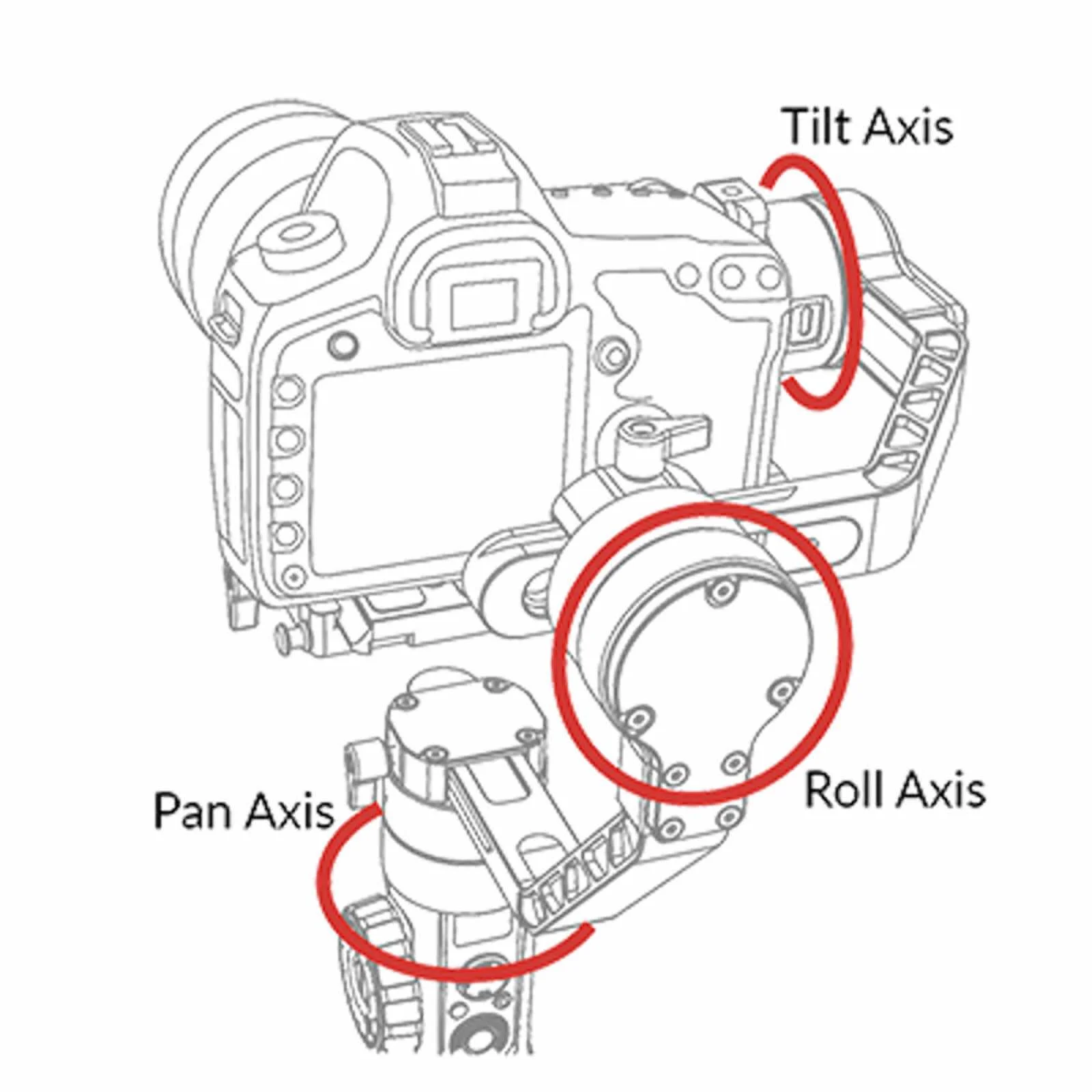
Gimbal on a mounted camera
The good thing about them is that they’re fairly lightweight compared to major motion picture stabilizers. They’ll demand less of you and really help with basic camera shake. Read more on the best gimbal stabilizers.
We’ve answered the question: “What is a gimbal?” But that’s just the beginning. In the next section, we’ll go over some basic operating strategies that will make this your new favorite piece of equipment.
EXTRA TIPS
Operating a gimbal
Now that we’ve defined what a gimbal is, here are some quick tips on getting the most out of them. Using one provides a lot versatility in the quality and types of shots possible. When you know the advantages, you’ll be ready to maximize this particular piece of equipment.
SET THE BALANCE
Make sure to balance your gimbal, otherwise you’ll be dealing with unnecessary shake. Watch the how-to video below.

How to balance your gimbal
Balancing is a necessary step. But once you’ve done that, you’ll be able to capture smooth and dynamic shots with ease. Now, that you’re ready to shoot, here are a couple strategies to keep in mind to create the most slick and professional looking shots on the cheap.
SHOOTING TIPS
The video below talks about how to create quality gimbal shots. For such a simple piece of equipment, watch how simple tricks like using the foreground can make your images pop.

Learn a few more techniques
PLACE SUBJECTS IN FOREGROUND
Here’s a quick tip. In your shot list, make sure your shots have something interesting in the foreground of the shot. It will really emphasize the camera’s movement. If you move it around empty space, you’ll miss the opportunity to use the gimbal’s potential.
Now, if you’re moving it around a subject standing still, the viewer is more interested in what you’re showing them, because they see them in relation to the background. It’s easier to see the sleek movement gimbals create when there’s something to look at.
GET CLOSE
Also, when using one, don’t be scared to get up close and personal. That’s the uniqueness of this equipment — you can capture tight moving shots. Get low to the ground and follow a person walking down the street. Try out different angles.
Now that you know what kinds of shots you can get using a gimbal, you can start shot listing.
GIMBAL VIDEO PLANNING
Plan your shots
You don’t have time to waste so always plan out your shots. Shot lists are your shooting blueprints. And with modern software, it really doesn’t take too much of your time.
Even though the gimbal is simple enough mechanism, make sure you schedule your shots accordingly. One tip is to shoot all your gimbal shots together to avoid wasting time mounting and un-mounting the camera between shots.
In this post, we provided a definition, illustrated the basics of how this equipment works, and even included a couple tips for how to maximize their benefits.
Now it’s up to you to get out there and shoot some dynamic and clean gimbal shots. They will add a level of professionalism to your project without breaking the bank.