Monday Feb 8th- LESSON: Pedestal- Film crane and camera jib

**NEW** DAILY ATTENDANCE QUESTION**
1) CLICK TO ANSWER DAILY ATTENDANCE QUESTION
- Click Student Login
- Type in Room # 310569
- Type in your Last Name, (then) First Name
- Answer Daily Attendance Question

Watch the three video’s as part of the Greatness Studio Starters 1) Bell Ringer Video 2) CNN 10 News 3) Motivational Video
BELL RINGER: CLICK TO WATCH VIDEO
CNN 10:CLICK TO WATCH CNN 10
MOTIVATIONAL MESSAGE OF THE DAY:CLICK TO WATCH VIDEO

Watch, Listen, Read everything in the Lesson below.
LESSON: Pedestal- Film crane and camera jib
VIDEO: CLICK TO WATCH
POWERPOINT: CLICK TO READ AND REVIEW
MORE INFORMATION: CLICK TO READ AND REVIEW
MORE INFORMATION #2: CLICK TO READ AND REVIEW
LESSON NOTES:
Pedestal Shot
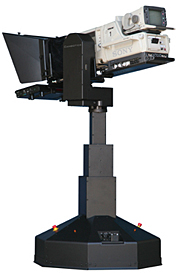 A pedestal shot means moving the camera vertically with respect to the subject. This is often referred to as “pedding” the camera up or down.
The term comes from the type of camera support known as a pedestal (pictured right). Pedestals are used in studio settings and provide a great deal of flexibility as well as very smooth movement. Unlike standard tripods, pedestals have the ability to move the camera in any direction (left, right, up, down).
Note that a pedestal move is different to a camera tilt, which means the camera is in the same position but tilts the angle of view up and down. In a ped movement, the whole camera is moving, not just the angle of view.
In reality, like most camera moves, the pedestal move is often a combination of moves. For example, pedding while simultaneously panning and/or tilting.
When filmmakers need to move the camera vertically in smaller movements, they opt for the pedestal. Pedestal shots are great for matching the movements of actors. They’re also great for reveal shots, which few do better than Quentin Tarantino.
Check out how he uses a pedestal shot in the opening scene of Inglourious Basterds to create suspense.
CLICK TO WATCH EXAMPLE FROM INGLOURIOUS BASTERDS
Tarantino uses the pedestal often for these reveal shots, so be sure to keep an eye out for them in some of Tarantino’s best movies. Sometimes directors and cinematographers need to move the camera vertically, but in larger movements than a pedestal allows.
Film crane and camera jib
Though the scale of the rig may differ, the terms “film crane” and “camera jib” can be used interchangeably. Both versions of this type of camera gear utilize a jib arm to extend a camera outward, enabling the camera to move up, down, left, or right in large movements.
Camera jibs and cranes are great for crane shots and camera boom movements. Camera booms are vertical movements that are often used in establishing shotsto show off the world of a film.
In film crane movements can also reflect a character’s emotions as it moves away from them. This is often used in moments of helplessness and isolation.
Crane shots and camera jibs can create smooth, large movements that have resulted in some of the most iconic shots of all time. They immediately elevate the production value and spectacle of a scene. Cranes can be incredibly expensive, but there are various camera jibs that provide an affordable option to all filmmakers.
he crane shot allows the audience to leave a normal point of view, creating a novel perspective that’s inherently cinematic. Whether you’re an aspiring filmmaker or intermediate enthusiast, getting comfortable with how to shoot with cranes will only enhance your craft. It’s not complicated and you don’t know need super expensive equipment to do it. So what is a crane shot? And what can you use it for? Let’s jump in.
Crane shot definition and applications
How can you use the crane shot to take your filmmaking to the next level? The operation of the crane isn’t so complicated and it does a lot of the work for you. We’re going to get into some practical applications of the crane shot, including examples from Django Unchained and La La Land, but first we need to lay out a quick definition.
CRANE SHOT DEFINITION
What is a crane shot?
A crane shot is taken by a camera mounted on a jib or crane that moves up and down. The terms ‘jib’ and ‘cranes’ are used interchangeably. The main function of a jib is to extend your camera out over a tripod, moving the camera up, down, left, right, or in any of those combinations. Certain jibs can keep the camera level and parallel to the ground no matter how you move them.
A jib sits on a tripod and it can also pan from left to right. The fulcrum or center point of gravity on the jib allows the up and down movement. Every jib has a counter-weight system where a weight is placed on the end of the jib in order to balance its movement. This allows for smoother motion, and less manual input by the camera’s operator. Some larger cranes operate by remote control.
WHY IS A CRANE SHOT USED?
- Sets the scene — establishes geography and the world of the story
- They can end films, shows, or videos with the classic “riding off into the sunset” moment
- They can be used to show large crowds or sets

- What is a Pedestal shot?
- What is a Pedestal shot used in films?
- What is crane shot?
- Why is a crane shot used?
- What is a camera jib? How is it used?