Click to Watch Camera Shots Review
Click for Top 20 Most Amazing Photos
Click for Intro Video to Shot Composition
Click for 10 Rules of Photo Composition
Click to Watch Video on Shot Composition
————————————————————-
Daily Assignment Thursday 9/17
————————————–
1) Click to Read About Rule of Thirds
2) Click to Watch Video About Rule of Thirds
3) Answer the questions Below:
1) What is Rule of Thirds?
2) How is Rule of Thirds it used?
3) Why do you use the rule of Thirds?
4) Click to Watch Video of Rule of Thirds Example
5) Click to Study for Key Terms Test on Friday
———————————————
While rules are often made to be broken in the field of photography, most experts agree that five basic composition guidelines will produce higher quality photographs and provide visual interest to your shots. By incorporating these guidelines into your photographs, you can ensure that you capture not only the elements you are photographing, but also the artistic design that you wish to capture.
Simplicity
Many of the best photographs concentrate on a few basic elements. By highlighting only those components that add to your composition, you can focus the viewer’s attention precisely where you want it. Avoid cluttered backgrounds; by changing the angle or the perspective and getting up close to your subject, you can often produce a photograph that is visually stunning and has no distracting or extraneous elements that reduce the impact of your composition. Professionals often position the primary component of their photograph off-center to add even more visual interest to the finished product.

Rule of Thirds
Professional photographers know that each shot is composed of three different spatial elements. The foreground, middle-ground and background are all present in most landscape shots; by noting and incorporating this into shot composition, photographers can create visual appeal by naturally drawing the eye to the middle ground and focusing attention exactly where the photographer intends. By manually setting exposure levels and deliberately selecting shots with these elements, amateurs and professionals alike can create works of art, rather than mere photographs. We have a more in depth article on the rule of thirds here.

Balance
While balancing the physical components of a photograph is important, another aspect that is often overlooked is balancing the colors present in the shot. Color theory is an essential element in the art of photography. Shots that focus heavily on first-order colors, also known as primary colors, tend to be more dramatic. Certain colors, such as red, orange, and yellow, should usually be employed sparingly and limited to one or two elements of the shot since they tend to attract the eye and create dynamic tension within the photograph. Too many high-energy colors, especially in contrast to each other, can overwhelm the viewer and cause anxiety rather than producing the visual effects desired; by balancing strong tones with neutral ones, a more balanced composite shot can be achieved.

Framing
Professional shot composition requires perfect framing of each shot. This requires the inclusion of elements that give perspective to the main focus of the photograph. By being aware of the various components when composing a shot, the photographer can produce high-quality shots that include all the important elements while excluding extraneous material. Photography is the art of including some things while omitting others; this is the main object of framing. By choosing the elements to include, photographers engage in editing before the shot; by cropping the photograph after processing, the editing process continues afterward as well. Not only can you frame with your lense, you can also use objects in nature to frame.

Lines
Natural lines present in the shot composition, whether intentional or not, can give an added sense of depth and perspective to the photograph. By paying attention to these lines and using them to advantage to draw attention to the focal point of the shot, photographers can create tension and drama in their photographs and make a visual statement with each composition. Diagonal lines tend to create visual paths to lead the eye to the focal point; repetitive lines, on the other hand, are often interpreted by the eye as background, bringing the main focus into sharp relief against the repeated pattern of lines.

What is the Rule of Thirds?
One of the fundamentals of painting and photography, the Rule of Thirds is a technique designed to help artists and photographers build drama and interest in a piece. The rule states that a piece should be divided into nine squares of equal size, with two horizontal lines intersecting two vertical lines. Elements of the composition should take care to not cross the lines, and points of interest in the work should land near where two lines intersect, known as a crash point.
Lines explaining the Rule of Thirds
 |
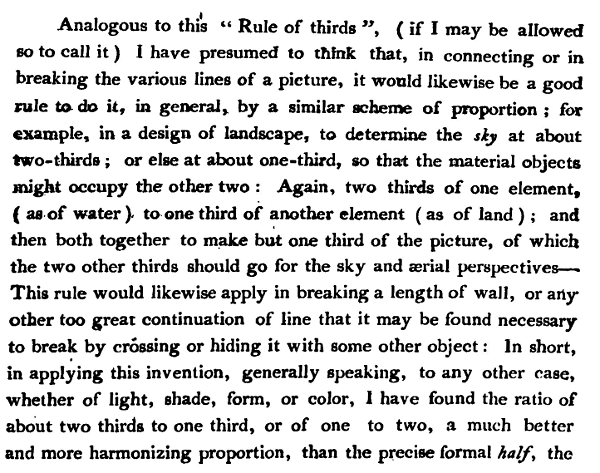
The rule was first written down more than 200 years ago and has remained a useful piece of advice for aspiring photographers and artists ever since. Of course, this predated the invention of photography by quite some time but the rule had become established by that point.
Of course, like all guidelines in art, the Rule of Thirds is merely a suggestion. Photographers should not feel the need to adhere constantly to respecting the rule, as ultimately it does not always produce the best results. However, for those still gaining experience, it does provide a useful strategy in learning how to best frame shots.
Early source of the Rule of Thirds
 |
Examples of the Rule of Thirds in Action
Images With and Without the Rule of Thirds Applied
Below are two copies of the same image. In the first, the photograph in question was cropped without regard for the Rule of Thirds. While it is supposed to showcase a series of townhouses in Bath, England, the focus is really more on the grass. Indeed, the lawn dominates almost half the picture, which combined with the sky above, means that the townhouses make up only a small fraction of the total image.
Photograph without respect to the Rule of Thirds
 |
In the second image, the same photograph was cropped with the Rule of Thirds in mind. While some of the townhouses to the right of the image were sacrificed in the effort, the whole imagine is much more composed. The eye is drawn to elements of the house that despite being visible in the first image are now of much more interest. Particular among these is the change in color of the façade of each house. Indeed, some of these changes are framed by the vertical lines.
Above image cropped with respect to Rule of Thirds
 |