December 22

10 Best Holiday Movies of All Time!!

Here Is Your Ultimate Guide to the 10 Best Holiday Movies of All Time

CHRITMAS TV 

Ahhhh, the holidays. Well, they’re not here yet, but they sure are creeping up on us. And what do we all associate the holidays with? Well, besides scrambling to buy the most unique and thoughtful Christmas gift for your significant other (no pressure)… that’s right… movies! Of course, family and friends are pretty good, too, but I’m pretty sure we need to make sure you have your viewing schedule lined up for all those free hours in between meals.

Over the years, there have been many films that have tried to capture the spirit of the holidays. Some of those have been hits and some of them have been misses. Huge misses. Then there are those films that don’t really revolve around the holidays, but take place during that time and, as such, have become synonymous with the season. Between these two types of categories, there is a solid selection of flicks for you to have prepped for your approaching free time.

I’ve crafted the perfect list here to bring you all the basics; your Christmas movies, your Thanksgiving movies and your awesome movies that happen to take place during the festive season. Follow this list and you’ll never groan about the holidays again.

2014-11-21-bestholidaymovies.jpg

10. National Lampoon’s Christmas Vacation (Don’t miss the hilarious trailer here!)

This seems like a great place to get started. I know that this is not up there with the first in the series, or even the European Vacation sequel, but this still hits some hilarious notes. From Randy Quaid’s fake turtleneck, to Julia-Louis Dreyfuss’ yuppie neighbour schtick, we get a solid does of classic 80’s-90’s humour. But we also get those warm holiday moments where it all comes together to make us believe in the spirit of Christmas…even if it required some hostage taking.

9. Home Alone (Don’t miss the hilarious trailer here!)

Talk about an instant classic. When this film came out in 1990, it was a box office sensation. Never mind the fact that the great John Hughes wrote it, it launched the biggest child star career since Richie Rich graced the comics. For a little tyke, Culkin has amazing comedic timing and expressions that will generally make you laugh out loud as he single handedly annihilates two criminals trying to infiltrate his home (played with great over-the-top zeal by Joe Pesci and Daniel Stern). And if that doesn’t sell you, well good luck not choking up when little Kevin finally sees his mom at the end.

8. A Christmas Story (Don’t miss the hilarious trailer here!)

This is easily the ultimate Christmas classic for any child of the ’80s. Even if you missed that time period, there have been numerous re-releases because this film is an undisputed classic for the ages. One child’s obsession with getting his one dream gift, the Red Ryder B.B. gun, string the whole mess together, but along the way we are all reminded of just how everything about our families can become polarized during the holiday season. If Ralphie’s plight does not resonate with you then you either skip Christmas or you don’t have a heart. Either way, this is required viewing you cold hearted jerk.

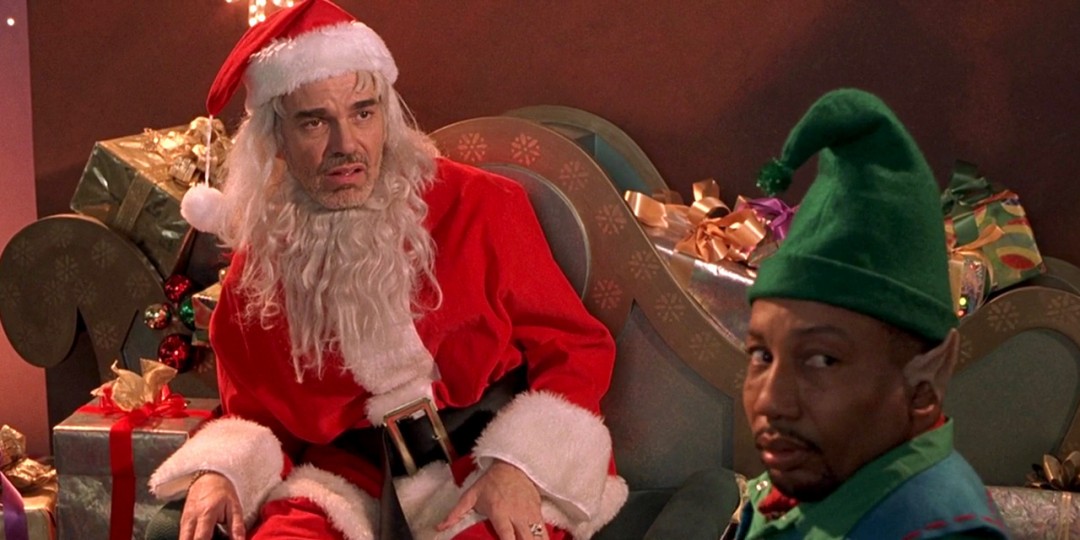
7. Bad Santa (Don’t miss the hilarious trailer here!)

Probably one of the most offensive holiday films ever made, Bad Santa still manages to make you get that ol’ magic feeling by the end. It may be tough to watch Billy Bon Thornton as the scoundrel Willy, a man who poses as Santa to rob shopping malls in the after hours, but it is even tougher to keep a straight face. Add a sexy appearance by Lauren Graham, the funniest kid you’ve ever seen, and the angriest dwarf you’ve ver encountered and you have the makings of comedy gold. There are many raunchy moments here, but the film’s central arc is Willy’s relationship with this sad, lonely kid that keeps the film from spiralling into pure debauchery.

6. Love, Actually (Don’t miss the hilarious trailer here!)

Stop scowling. This film is exceptional in what it sets out to do. There are at least six different stories going on in here and they all overlap in genius, and subtle ways… each one which brings its own great message about love and the role it plays in all our lives. This is probably one of the best date movies ever, so if that is all you need over the break, then let this one be it. Alan Rickman, Emma Thompson, Hugh Grant, Colin Firth and a host of others bring serious acting pedigree, while director Richard Curtis has managed to make something here that is now on most people’s holiday viewing list.

5. Trading Places (Don’t miss the hilarious trailer here!)

This is one of the funniest moves ever made. I watch this every Christmas with a buddy of mine and we call it a Christmas movie. In fact, it really is a Christmas movie as the season plays a big part in many scenes and even some motivations for some the leads. Leads? Oh. Just Eddie Murphy and Dan Aykyroyd at the top of their games. These days, it would be tough to make a movie with this subject matter and racial humor, but back then it all worked. If they ever try to reboot this, you will find me hiding under a table in a cabin deep in the woods.

4. Scrooged (Don’t miss the hilarious trailer here!)

I had to put one of the incarnations of this story on this list. There are many to choose from, but this is at the top of my old DVD pile in the country house for a reason. Bill Murray’s Frank Cross is a wonder to behold in all his manic, malicious and, ultimately, redeemed behavior. Richard Donner’s effects and strategy help this film never slow down and allows for Murray to really go for it. We all know the story, but bringing it into a contemporary setting and having Cross be an executive peddling trashy television content to the masses really fit the themes well. With a little help from Bobcat Goldthwait as the unlucky recipient of much of the abuse, the final act is downright awesome.

3. Planes, Trains And Automobiles (Don’t miss the hilarious trailer here!)

I miss John Candy. I really do. Whenever I watch this movie it is such a stark reminder as to how talented he was and how much range the man had. Pairing him with Steve Martin in a film by John Hughes is just almost as perfect as a holiday themed movie can get. This is not a Christmas movie, though. Martin is trying to get home for Thanksgiving and he just can’t seem to get there on his own and becomes saddled with Candy’s overbearing and over-friendly shower curtain ring salesman, Del. The journey is hilarious and the final sentiments hit the nail on the head about friendship and family. This is an all time classic, gents.

2. Elf (Don’t miss the hilarious trailer here!)

Will Ferrell plays a human who was raised as an elf. It’s directed by Jon Favreau. Watch the trailer and you tell me if this should not be compulsory viewing during the coming months. If you only have room for one extremely Christmas heavy film during your build up to the 25th of December, then let this one be it.

1. Die Hard and Die Hard 2 (Don’t miss the hilarious trailer here!)

I may be biased here because these are my favorite movies of all time. And to be fair, these are not your basic Christmas movies. But this list is not simply about finding the best Christmas movies as much as it is about finding the best films that have some of that holiday spirit at heart. And John Maclane’s first two movies fit that bill. In both of these, our hero is trying to make some family time around the season and he gets interrupted by terrorists or thieves or just basic bad guys. In case you missed it, these guys are a metaphor for our own metaphysical obstacles that impede our ability to reconnect with the important things this time of year. Sort of. But who cares? These flicks rock and make for some fun holiday TV time.

December 19

Check List for this Week 12/15-to-12/19

**MAKE UP FRIDAY****

Check List for this Week 12/15-to-12/19

———————————————-

1) Project      

           Movie Genre Switch    ___ (45%)

2)  Test

          Chapter 11 Lighting (Today 12/19)  ___ (40%)

3) Daily Assignment

          12/16 Daily Assignment                    ___ (15%)


***You can make-up any Project, Test or Daily Assignment until Tuesday Dec. 23rd** After that point when we come back for 2015 it’s too late!!

Test for this QTR-  Chapter 6, Chapter 7, Chapter 8, Chapter 9, Chapter 10 and Chapter 11

Projects for this QTR-  (1) :30 Commercial and :60 Commercial (2) One Minute Movie No Cut (3) Long One Take Movie (4) Shot Types (AM ONLY) (5) Foley Sound Project (6) Chaplin Power Point (AM ONLY) (7) Silent Movie (8) Silent Movie Trailer (9) Movie Trailer Genre Change

Daily Assignments


December 17

College Spotlight- Syracuse University Newhouse School

College Spotlight- Syracuse University Newhouse School

Click for the Syracuse University Newhouse School Website

Click to Watch the Newhouse and You Video

The Newhouse School is one of the nation’s top schools of communication, preparing students to become leaders in a rapidly changing media landscape.

It’s impossible to ignore the “infoquake” that is moving and shaking global public communications. Across the world, people are changing the ways they give and receive information. Instant mobile technology is driving communicators to rethink everything we’ve learned and reimagine the possibilities.

Here at the Newhouse School, we aren’t simply reacting to the new media earth moving beneath our feet.  We are teaching traditional methods with new tools, and preparing our students to successfully lead and innovate in today’s communications industry.

The strength of the Newhouse School is firmly rooted in the quality of the education offered in its classrooms; an extensive network of loyal, accomplished alumni; and innovative programs and opportunities, such as theSULA SemesterThe NewsHouse and the Center for Digital Media Entrepreneurship.

Whether you’re interested in journalism, visual and interactive communications, advertising, public relations or television and film, you will find a wealth of choices and a richly experienced faculty here at the Newhouse School. We welcome students who are curious about the world and who want to change it for the better through mass communications. Join us.

Lorraine Branham
Dean

December 17

Chapter 11 Lighting Key Terms For Friday 12/19 Test

Chapter 11: Lighting

KEY TERMS TEST FRIDAY 12/19

CLICK TO STUDY WITH QUIZLET

1. barn doors Metal flaps mounted in front of a lighting instrument that control the spread of the light beam.
2. baselight Even, nondirectional (diffused) light necessary for the camera to optimally. Normal base light levels are 150 to 200 foot-candles (1,500 to 2,000 lux) at f/8 to f/16.
3. broad A floodlight with a broadside, pan like reflector.
4. clip light Small internal reflector spotlight that is clipped to scenery or furniture with a gator clip. Also called PAR (parabolic aluminized reflector) lamp.
5. color temperature The standard by which we measure the relative reddishness or bluishness of white light. It is measured on the Kelvin (k) scale. The standard color temperature for indoor light is 3,200K, for outdoor light is 5,600K. Technically, the numbers express Kelvin degrees.
6. cookie A popularization of the original term cucoloris, Any pattern cut out of thin metal that, placed inside or in front of an ellipsoidal spotlight (pattern projector), produces a shadow pattern. Also called gobo.
7. dimmer A device that controls the intensity of light by throttling the electric current flowing to the lamp.
8. ellipsoidal spotlight Spotlight that produces a very defined beam, which can be shaped further by metal shutters.
9. flag A thin, rectangular sheet of metal, plastic, or cloth used to block light from falling on specific areas. Also called gobo.
10. floodlight Lighting instrument that produces diffused light with a relatively undefined beam edge.
11. fluorescent Lamps that generate light by activating a gas-filled tube to give off ultraviolet radiation, which lights up the phosphorous coating inside the tube.
12. foot-candle (fc) The amount of light that falls on an object. One foot-candle is the amount of light from a single candle that falls on 1-square-foot area located 1 foot away from the light source.
13. Fresnel spotlight One of the most common spotlights, named after the inventor of its lens. Its lens has stoplight concentric rings.
14. gel Generic term for color filters put in front of spotlights or floodlights to give the light beam a specific hue. Gel comes from gelation, the filter material used before the invention of more durable plastics. Also called color media.
15. HMI Light Stands for hydragyrum medium arc-length iodide light. Uses a high-intensity lamps that produces light by passing electricity through a specific type of gas. Needs a separate ballast.
16. incandescent The light produced by that hot tungsten filament of ordinary glass-globe or quartz-iodine lamps (in contrast to fluorescent light.
17. incident light Light that strikes the object directly from its source. An incident-light reading is the measure of light in foot-candles (or lux) from the object to the light source. The light meter is pointed directly into the light source of toward the camera.
18. Kelvin (K) Refers to the Kelvin temperature scale. In lighting it is the specific measure of color temperature–the relative reddishness or bluishness of white light. The higher the K number, the more bluish the white light. The lower the K number, the more reddish the white light.
19. LED light Stands for light emitting diode light. Its light sourse is an array of semiconductors (a solid-state electronic device) that emits light when electricity passes through. Can produce different-colored light.
20. lumen The light intensity power of one candle (light source radiating isotropically i.e. in all directions)
21. luminaire Technical term for a lighting instrument.
22. luminant Lamp that produces the light; the light source.
23. lux European standard unit for measuring light intensity.
24. neutral density (ND) filter Filter that reduces the incoming light without distorting the color of the scene.
25. patchboard A device that connects various inputs with specific outputs. Also called patchbay.
26. pattern projector An ellipsoidal spotlight with a cookie (cucoloris) insert, which projects the cookie’s pattern as a cast shadow.
27. quartz A high-intensity incandescent light whose lamp consists of a quartz or silica housing (instead of the customary glass) that contains halogen gas and a tungsten filament. Produces a very bright light of stable color temperature (3,200K) Also called TH (tungsten-halogen) lamp.
28. reflected light Light that is bounced off of the illuminated object. A reflected-light reading is done with a light meter held close to the illuminated object.
29. scoop A scooplike television floodlight.
30. scrim A spun-glass material that is put in front of a lighting instrument as an additional light diffuser or intensity reducer.
31. softlight Television floodlight that produces extremely diffused light.
32. spotlight A lighting instrument that produces directional, relatively undiffused light with a relatively well-defined beam edge.
December 16

12/16- Daily Assignment- Movie Genres

12/16-  Daily Assignment-

1) List and define ten movie genres

2) After you list and define ten genres go back and list your favorite movie from each of the genres you listed.

3) What is your favorite movie genre and why?  (SEND THE INFO FOR THE FIRST THREE ASSIGNMENTS IN THE COMMENT SECTION OF THIS POST)

4) CLICK TO WATCH THIS POWERPOINT ABOUT MOVIE GENRE

5) CLICK TO WATCH MORE MOVIE GENRE TRAILER CHANGE EXAMPLES

A) CLICK TO WATCH NIGHT AT THE MUSEUM

B) CLICK TO WATCH GENRE CHANGE PROJECT: WINNIE THE POOH AS A HORROR FILM

6) EDIT YOUR GENRE CHANGE PROJECT


December 15

Project- Genre Shifting Movie Trailers

PROJECT- GENRE SHIFTING MOVIE TRAILERS


Take movie clips and retell the plot of the story in a different genre than the original. Examples: The Shinning as a romantic comedy, Marry Poppins as a dark horror film, Ferris Bueller’s Day off as an indie “coming of age” film and Mrs. Doubtfire as a horror film.

Click to see Examples

Objectives:

This Genre-Shifiting Video Project is valuable in a number of ways.

1) Students to think deeply about the grammar of storytelling while considering essential elements of creating video.

2) How to use of music, timing, edits/cuts, effects, pauses/silence is used for various genres.

3) Students will have to acquire a keen eye for the curation involved in finding and gathering elements that would support a chosen genre.

4) This video are great for discussing questions around how film directors/producers makes us feel a certain way through the thoughtful use of various edits & visual/auditory/stylistic elements.


Due Date- Tuesday Dec. 16th

ASAP- I will approve your genre shifting movie. What movie will you be using and what genre will you be changing it too.


December 15

12/15- Film Generes

CLICK TO TAKE MOVIE GENRE QUIZ

CLICK TO WATCH INTRODUCTION TO FILM GENERS


Film genres are used to categorize movies based mostly on plot lines, but also takes style, setting, and characters into consideration. Genres can overlap, and many movies fall into more than one broad category. The following genres are the most common ones used to classify films.


Action Films

Action movies include the heart-pumping, high-energy scenes that get people talking long after the film has finished. Some typical elements of action movies include brawls, car chases, natural disasters, and martial arts.

Like some other genres, the plot of this type of film usually revolves around a battle between good and evil. The characters can range from everyday heroes and bad guys to high-tech robots and machines. Most big-budget films are action movies, simply because of the cost involved in putting these blockbuster scenes together.

Examples of action movies include:

  • X-Men
  • The Matrix
  • Fast and Furious

Adventure

The adventure genre is based on story-telling. Often combined with at least one other genre such as action or science fiction, adventure films weave richly detailed settings together with a plot based on a journey or quest. Common themes in adventure movies include time travel, treasure hunting, historical time periods, and coming of age. These movies often contain a moral or social commentary. Some examples of adventure films are:

  • Star Wars
  • Pirates of the Caribbean
  • The Chronicles of Narnia

Comedy

Any movie that is designed to make people laugh falls under the comedy umbrella. Whether it’s an animated movie suitable for the whole family or a bawdy adult film, if it’s meant to be funny, it’s a comedy. There are many sub-genres of comedy, including romantic comedies, physical or slapstick comedy, and dark comedy. In this genre the plot is usually light, with the focus on the actors and their ability to amuse their audiences. The following films are considered comedies:

  • Caddyshack
  • The 40-Year-Old Virgin
  • Home Alone

Crime

Crime films are almost always dramatic in nature, encompassing the many angles of both enforcing and breaking the law. Plot lines most often focus on the criminals themselves, from petty thieves to mafia or international crime rings. Other crime films feature the men and women who fight crime, from traditional police officers and detectives to elite groups established under a cloak of secrecy. Examples of crime movies include:

  • The Godfather
  • Ocean’s 11
  • Pulp Fiction

Drama

The drama genre is very wide, encompassing almost any movie that combines a serious plot with believable characters. The stories told in dramas revolve around the characters themselves as they face conflicts, both external and internal. Many drama films are biographies of real or fictional people, while others delve into serious issues such as politics, illness, substance abuse, and relationships. Some good examples of dramatic films include:

Epic

Epic movies tackle larger than life settings, often with a very large cast, to tell a story in the most dramatic and extravagant way possible. These are often historical or mythical pieces, covering subjects like battles, royalty, biblical tales, and mythical figures. While the story itself is important to the film, the real impressions are made with elaborate costumes and sets. Epics are expensive to make considering all of the lavish details, and they tend to draw big-name Hollywood actors. Some epic films that you may recognize are:

  • Lawrence of Arabia
  • The Passion of the Christ
  • Titanic

Family

family watching a movie

Family movies are for all ages.

Family is another movie genre that includes many different forms. These are films that are fun for the entire family to watch together, from children to grandparents. Disney films are great examples of family movies, whether it’s live action or animation. Family movies often include teaching moments when characters deal with issues or situations familiar to kids. These films are often comedic in nature but can also include drama and other film genres. A few titles from the wide range of family movies are:

Horror

Horror movies are intended to frighten and thrill audiences, using a number of different techniques. From gory slasher films to disturbing psychological thrillers, horror movies play on fears and edge-of-your-seat drama. Many different themes can be found in these movies including monsters, the paranormal, serial killers, and the occult. Classic examples of horror films include:

Musicals

If the main hook of a movie is its soundtrack, chances are that it’s a musical. Musical films incorporate songs and often dance numbers into the plot, making them the highlights of the storyline. Sometimes the music is written for the movie, while sometimes it’s the other way around. Musicals can be adapted from a theater production, or even based on the biography of a musician or singer. If you’re interested in seeing what musicals have to offer, try one of these titles:

Science Fiction

Science fiction movies take viewers into a world of amazing and futuristic technology, where space travelers roam innumerable universes, aliens live amongst us, and almost anything is possible. From mad scientists creating new life forms to brave explorers conquering time travel or outer space, science fiction pushes the boundaries of what is possible or what might be possible in the future. Examples of science fiction films include:

Western

Westerns encompass some of the earliest films in American history, detailing life on the early frontiers. Gun-slinging cowboys battling natives, exploring the land, staking their claims, and winning the hearts of fair damsels are all common themes in Western films. The “Wild West” is the backdrop to these tales, which feature all the classic trademarks like saloons, horses, and heroes. Some good examples of Westerns include:

  • The Magnificent Seven
  • Butch Cassidy and the Sundance Kid
  • The Good, the Bad, and the Ugly

Using Film Genres

As a movie watcher, you can use these film genres to narrow down your search for an appropriate film to watch. Whether you’re buying, renting, or streaming a movie, most stores and websites sort their titles by genre, making it easy to select the type of film you want to see. Though numerous movies fall into more than one category, the overall characteristics of plot, characters, and setting will usually place any film into a well-defined genre.

December 12

Check List for This Week 12/8-to-12/12

Check List for This Week 12/8-to-12/12

————————————————–

1)  Projects

             A) Silent Film   ____  (45 %)

             B) Movie Trailer  ___ (45 %)

2) Key Terms Test (Friday)   ___ (40%)

3) 12/10 Daily Assignment-  ____ (15%)

4) 12/12 Daily Assignment-  ____ (15%)

**Make-Up Friday–Get all of the above work done today***

*******************

12/12 Daily Assignment- Study for today’s key terms test…play three games and take the practice test on quizlet..Post your scores to the comment section of this post.

Click to Study with Quizlet

*******************

December 10

The Art of First Impressions: How to Cut a Movie Trailer

Click to Watch How to Make a Great Movie Trailer

Click to Watch How to Make a Epic Movie Trailer

Click to Watch Top 10 Movie Trailers of All Time

12/10- Daily Assignment- Read below–Make a list of ten tips about making a Movie Trailer.  Send the list in the comment section of this post.

The Art of First Impressions: How to Cut a Movie Trailer

It’s only two minutes long. But it’s the way a film greets the world. For a self-distributor, it can mean getting 100,000 hits on YouTube within a week. For indie filmmakers trying to make an impression, it’s a chance to have their no-budget D.I.Y. movies stand shoulder-to-shoulder with The Hobbit and Avatar 2 on iTunes. And it has a long shelf life; years after a theatrical release is over, it will be one of the first things to pop up on a Google word search.

The humble movie trailer, once a delightful distraction seen only by punctual film goers exclusively in movie houses, is now the principal way most movies get exposure and remain in the public conscience. And as long as there is a computer and an Internet connection, it can be watched anytime, anywhere, indefinitely. Along with the movie poster, it is arguably the most important marketing tool available to a filmmaker.

A bad trailer won’t automatically hurt a film. Strong reviews and terrific word-of-mouth can make uninspired advertising irrelevant. Then again, not all films are bulletproof success stories. What about that promising first feature? That peculiar but compelling foreign language film? That oddball documentary with seemingly banal subject matter yet an undeniably hypnotic style? These kinds of movies can really benefit from a memorable piece of advertising. (And, oddly enough, a bad flick can occasionally make for a fantastic trailer. More on that later.)

Studio films typically break down into a handful of genres: action, drama, comedy, horror, sci-fi, fantasy. They all have their conventions, and their trailers have a similarly categorized look and sound. Thick sans-serif font with jaunty music? Comedy. Elegant serif font with dour orchestral cue? Drama. These are mass-produced goods, and they are by definition formulaic. This is not necessarily criticism; there are excellent studio films that have accordingly superlative trailer work. (Trailer campaigns for huge franchises such as The MatrixHarry Potter and Spider-Manare particularly well-crafted.) But independent and foreign language releases are usually hard to categorize. They often mix genres, subvert them or ignore them completely. Documentaries, too, can defy definition. Is it an essay film, an experiential meditation, agit-prop, social commentary or all of the above?

At Kinetic, the company my partner Christy Wilson and I co-founded 10 years ago, we have had the opportunity to work on tremendous non-studio movies that aren’t the easiest to categorize; over 300 films, most recently Cary Fukunaga’s Jane Eyre, Agnieszka Holland’s In Darkness, Constance Marks’ Being Elmo: A Puppeteer’s Journey, and Tom Six’s The Human Centipede 2: Full Sequence. From a marketing point of view, the options are wide open — which can be either intimidating or liberating, depending on your point of view.

GETTING STARTED

So you have a movie and you need a trailer. Put very simply, a trailer is a condensed version of a feature, so it should be a collection of its greatest elements. The best way to evaluate your film is to see it first not as a genre but in terms of its fundamental characteristics. Does it have arresting dialogue? Great cinematography? Searing performances? Memorable production design? Lead with its merits.

Of course genre will guide the trailer process. But which aspects are the best ones to market? If it’s a comedy/drama, do you make it funny with some gravitas, or serious with a few zingers for levity? Do you let genre define the film? Doing so might attract more ticket buyers, but could also alienate those people if the movie they see doesn’t match their presumptions. Also, if the film has played on the festival circuit, consider using laurels to tout its pedigree. Are there good reviews, and do you want to add them to the mix? Or will laurels and reviews attract only a highbrow audience and alienate the general market?

Do you think the trailer would benefit from a narrator? What kind of music is available — are there cues specifically composed for the film that would be appropriate, or is outside music a possibility? Do you want a copywriter to get involved, or does the film have enough explanatory dialogue to sustain itself? Now that you’ve unpacked your elements, decide on a creative approach.

RHYTHM AND STRUCTURE

Above all, and without exception, trailer editing is about rhythm. If you don’t have an innate sense of it, then your trailer will not sing. A trailer, cut well, will have a flowing motion to it, a sense that everything plays off everything else, and will propel the viewer through the experience of the film. Trailers build up excitement and anticipation, and a keen sense of rhythm heightens those sensations.

While you may not choose for music to be the defining characteristic of your trailer, it still plays an important role in its basic construction. It literally sets the tone and the rhythm. I usually start every trailer by building my music bed, and that bed is generally composed of three music cues. Why three? Because trailers lend themselves to a three-act structure.

Act One: Introduce the films’ characters and environment. Act Two: Complicate their world with obstacles to overcome. Act Three: Intensify the conflicts and ratchet up the tension/excitement/humor. (Montages invariably end up in Act Three.) There can be four acts, there can be one — it really just depends on the material. But three acts is a good place to start. Most importantly: never resolve anything! Whenever possible, leave questions unanswered. Don’t tie up loose ends. Keep the audience wanting more.

I mentioned before that bad movies can have great trailers. That’s because trailers are about raising expectations. Films are made because a group of people really believe in the ideas behind that movie. All films start out being potentially great. By the time the filmmaking process is over, reality has intervened. Is it still great? That’s open to debate. But a trailer doesn’t reveal the whole movie. It just reveals the movie’s potential to be great. It pitches the promise of the premise. And if the trailer has seductive rhythm and an arresting structure, then any movie can look like a winner.

DISASSEMBLING YOUR FILM AND CONSTRUCTING YOUR TRAILER

In order to make a trailer for your film, you have to take it apart. Every trailer editor goes through the film meticulously, breaking it down and turning it into basic building blocks. The main way to do this is to create two sequences: a dialogue string and a visual string. These are highlight reels. But they’re also like basic ingredients. Imagine taking a cake and reverse-engineering it, extracting the eggs, flour, sugar and butter.

Editors are like tailors. They cut materials and shape them, letting them out here and tucking them in there, until they make a perfect fit. But editors, particularly trailer editors, are also cooks. They take their materials and they boil them down, condense them and extract their essence in order to flavor the overall meal.

Common sense might suggest that the editor who cut your feature should cut your trailer, too. But in certain ways they are the least qualified. Yes, they are familiar with the footage, and trailer editors need to be, too. But feature editors are too familiar. They have lived with the footage for months, sweated over the choices and labored to make every shot fit perfectly into the specific context of the film.

Trailer editors, on the other hand, are disrespectful. They de-contextualize everything. That half-smile the heroine gives to her boyfriend that secretly devastates him? The trailer editor only sees a smile. A dog bark is a dog bark. It’s not Spot’s excited howl that saves the life of his master — it’s just a dog bark. Trailer editors have to see everything for what they are inherently, not how they function in the feature film. They have to unpack the feature in order to repack it and turn it into a trailer.

There are also many familiar editing tropes in trailers: dissolves, fades from black, fades to black, white flashes with the metal-door slams, fast-paced flutter-cuts, double exposures, speed adjustments, audio rises, audio drones, audio stings. These effects are like the images from the film itself: they are tools in a toolbox. Got something lush and romantic? Use dissolves and fades. Got something fast-paced and tense? Use increasingly faster hard cuts that crescendo in a metal-door slam and a white flash. This is simplistic, but the basic message is this: Use these tools (the sound effects, the editing tricks, etc.) to tell a story. And to sell a story.


STRIKING THE RIGHT TONE

Certain films have subject matter that might turn off audiences who think they’ve seen that type of movie before. Myles Bender, senior vice president of creative advertising at Focus Features, was concerned that their new production of Jane Eyre would be perceived as too literary, too outdated and be viewed as a chick flick. He requested a trailer that played down the traditional romantic melodrama and emphasized something else: horror. So Wilson mined and exploited the darker, eerier aspects of the film and treated the story not as a treasured classic but as a very modern tale of madness and obsession.

Let’s say your film deals with controversial issues. Some people who might really love the movie may recoil when they learn what it’s about. Respect that. Don’t rub people’s noses in it. Be subtle. Or at least be tactful. In Ryan Fleck’s feature debut Half Nelson, released by THINKFilm, Ryan Gosling plays a beloved high school teacher who is also a crack head. When we did the trailer, we were very conscious of not naming what drug he was using. We alluded to drug use, but we weren’t specific. Also, this movie is about so much more than drug use. It’s also about adults inspiring teenagers, having human weaknesses and getting second chances in life. So we underlined the tragic parts, emphasized the positive and didn’t dwell on the more salacious, negative aspects.

Before we started Kinetic, Wilson cut the trailer for L.I.E., a critically acclaimed drama about pedophilia on Long Island, released by Lot 47. In this case, the material is so potentially toxic that it’s difficult to explain the story without it seeming lurid. But the movie had a melodic yet sinister song (Donovan’s “Hurdy-Gurdy Man”), sumptuous cinematography (courtesy of Romeo Tirone) and evocative shots (thanks to director Michael Cuesta). Lot 47 co-founder Jeff Lipsky asked Wilson to make a trailer using only the one song, drop all the dialogue, and cut a montage peppered with critics’ quotes and laurels. He asked her to create a mood instead of a narrative; something that was by turns alienating, thrilling, dangerous and ultimately haunting. Without saying a word, it is an incredibly faithful reflection of the film.

MUSIC-DRIVEN (AND MONTAGE-DRIVEN) TRAILERS

L.I.E. is essentially a music-driven montage trailer. The song and images dictate the feeling and structure, but don’t reveal a story. Certain filmmakers have such a distinct visual style and use of music that the best sort of trailer for their films is usually a music-driven montage. Gaspar Noé’s Enter the Void is a perfect example. The trippy film about the ghost of a junkie watching over his stripper sister in the neon-drenched city of Tokyo practically begs to be a visual head-trip trailer. IFC Films, who released the film, totally supported that approach, but vice president of marketing Ryan Werner and director of marketing Shani Ankori wanted to make sure the two main characters were also established. So the montage is book-ended with the two of them talking to each other and promising to always be together no matter what. Along with being a string of trippy images set to a pounding techno cue, the trailer also has an emotional undercurrent that humanizes the material and makes the psychedelica oddly poignant.

Another incredibly visceral filmmaker is Lynne Ramsay, whose 2002 film Morvern Callar, released by Cowboy Pictures, follows Samantha Morton as she assumes her dead boyfriend’s identity, claims his book as her own and becomes a celebrated author. Cowboy’s co-heads, Noah Cowan and John Vanco, wanted the trailer to tell that story, but they also wanted it to be impressionistic and to showcase the visuals and the music. The film has an incredibly eclectic soundtrack (Aphex Twin, Stereolab, Lee Hazlewood, Ween), and I used four different cues throughout. The story is about, essentially, an identity crisis, so the music keeps getting interrupted by stray bits of dialogue that are jolting realizations. The structure of the trailer is one of disruption and deliberately jerks from exultation to anxiety and introspection.

DOCUMENTARIES

Although documentaries are technically non-fiction, they usually abide by the same rules as fiction films. They tell a story. The trailer for the Zeitgeist release Bill Cunningham New York, cut by our junior editor Laura Tomaselli, is absolutely about fashion, since the subject is a fashion photographer. But it’s also about the sacrifices one person makes in order to do what he loves. She makes his story compelling in two minutes because she captures his monastic, Spartan lifestyle and contrasts it with flamboyant wealth. And she shows how this man has just as much individuality, taste and style as the most outrageous clotheshorse. It’s an eloquent ode to having the courage of one’s convictions—whether it’s what you wear or how you choose to live. And the opening line is a killer set-up. Icy Vogue editrix Anna Wintour says, “I’ve said many times that we all get dressed for Bill.” A power-broker like her, bowing to one man? Tell me more.

USING SUBTITLES

Years ago, distributors were wary of using subtitles in their trailers for foreign language films and relied on a narrator instead of dialogue to explain the story. More cynical minds might say that it was a lack of faith that audience members didn’t want to see something that wasn’t in English. But there’s a more practical reason: trailers go quickly, and it’s hard to read while so many images are flashing by. These days, trailers now happily carry subtitles. In this digital age, one could argue that people are far more adept at processing a barrage of information quickly. Regardless, subtitles are another tool for trailer editors. The question is, how to use them effectively?

For the most part, I treat foreign language dialogue the same way I treat English dialogue: to advance a story, set a mood and share emotion. The trailer for Cristian Mungiu’s 4 Months, 3 Weeks, and 2 Days, released by IFC Films, has 20 subtitles in it. But they convey urgency and tension (“What are you going to do?,” “Once we start, there’s no turning back,” “Want to tell me what’s going on?”). The dialogue doesn’t actually reveal information. It raises questions. The more subtitles, the more tense the trailer gets. (The trailer is also a good example of how to handle sensitive material; nowhere does it mention that the film is an abortion drama. The images hint at the plot, but nothing is explicit).

In the trailer for Tomas Alfredson’s Swedish vampire thriller Let The Right One In, distributed by Magnolia’s genre arm Magnet, I only use three subtitles. Halfway through, there’s a quick exchange: “Are you a vampire? / Would you like me anyway?”; and at the end, “Will you be my girlfriend?” Otherwise, the story in the trailer is told wordlessly, which Magnolia president Eamonn Bowles, as well as former senior vice presidents Tom Quinn and Jeff Reichert, completely supported. The economy of dialogue is helpful from a marketing point of view — there’s a good chance that U.S. horror fans with no knowledge of international cinema might give this one a look, even if they usually avoid subtitles. But less is also more; the spare dialogue increases the dramatic tension in a lovely, somber way.

USING COPY AND NARRATION

Copy and narration are an acquired taste. Because Hollywood movies overuse copy and narration, they can look and feel tired and uninspired. They are also literally disruptive; you’re watching a great image or listening to a line of dialogue, and then suddenly it’s interrupted by some deep bass voice or a card full of text. Conversely, if you can cut a trailer without copy or narration, then the movie is explaining its own story organically. Showing rather than telling is always more interesting, so I try my best to avoid copy and narration whenever possible.

That said, there are always exceptions to the rule. Copy is a great way to set up a premise quickly and economically. In the trailer forCarlos, Olivier Assayas’s sweeping five-hour epic about an international terrorist, released by IFC Films, it helped immensely to have three copy cards at the beginning: “IN THE 1970s AND 1980s / ONLY ONE MAN / COULD HIJACK THE WORLD.” That sets the time, place and global impact within seconds. BecauseBill Cunningham New York is an episodic portrait of a man, the trailer uses one-word copy cards that allow an impressionistic structure while reinforcing Cunningham’s identity: PHOTOGRAPHER. / PERFECTIONIST. / LONER. / MAVERICK. / VISIONARY.

MAKING A TRAILER ECONOMICALLY

Let’s say there’s just no budget to pay for music (either from a composer or from a music library). Or, even more importantly, the director chose not to use music for thematic reasons. Also, let’s say that there’s no budget for a copywriter or a narrator, either. None of these things is necessarily bad. Practically 99 percent of trailers have music, copy or narration, so those few trailers without them actually have an advantage in terms of standing out from all the others.

Kelly Reichardt’s Wendy and Lucy, about a down-and-out woman and her dog trying to get to Alaska, deliberately had no music, to accentuate the film’s stark, unsentimental mood. David Fenkel, president of Oscilliscope Laboratories, the film’s distributor, wanted Reichardt to be involved with the marketing, and she and I quickly decided not to use music in the trailer. We also both prefer not to use copy or narration. So that just left the film’s strongest asset: Michelle Williams. But her performance in the film is so riveting that we used her dramatic predicament to create the music and rhythms of the trailer. Her escalating desperation and increasingly extreme circumstances formed the structure of the trailer, and key bits of dialogue accentuated her stress and anxiety. There is innate music in the spoken word, if you listen for it.

IFC Films’ Day Night Day Night was another extreme situation. Julia Loktev’s harrowing depiction of a suicide bomber preparing to sacrifice herself is so narrowly experiential that the viewer never really knows what is happening at any given time. The movie is disorienting, so I tried my best to make the trailer equally so. I found structure in repetition; as the main character goes through her training, she repeats phrases and words that others give her. The natural rhythms that arose were the material that I used to give the trailer a shape and a sense of danger and emotional vertigo. No copy, narration or music was necessary.

REFERENCING THE TITLE

It sounds silly and even somewhat obviousbut if someone in the movie says the title of the film, you should consider using it in the trailer. If the film’s title is cryptic or somewhat elusive, then that dialogue can give it context and possibly even a sense of poetry. Why risk a ticket sale due to confusion about the title?

No one in Half Nelson explains the title. But when we were working on the trailer, we were allowed to use an outtake that explains it: a snippet of audio that intros a piece of music (“This song is called “Half Nelson,” for those times when you’re feeling kind of stuck”). It’s at the beginning of the trailer and was used as a cheat to seem as though Gosling is hearing it on his clock radio.

Morvern Callar has such a strange title that one could be forgiven for not thinking of it as a woman’s name. So at the beginning of the trailer, we use a piece of a phone conversation from the film (“Mervill Coller?” “No, Morvern Callar”) that makes light of the name — and we also show a computer screen where the name is being typed.

NO RULES, ONLY GUIDELINES

Everything I have written so far can be disproved by another trailer that I (or someone else) has done. My ideal trailer doesn’t have copy, narration or subtitles. But one of my favorite trailers is for Matteo Garrone’s Gomorrah, which I cut for IFC Films and which has — guess what? Very lengthy copy cards, a healthy dollop of narration and loads of subtitles. It’s incredibly helpful to have a three-act structure, with three distinct music cues. But the trailer for L.I.E. has exactly one song and only one act.

You never really know what shape a trailer will take until you start cutting it. Look at the film’s assets, weigh its limitations, and then find a rhythm and structure that works best. There is no one perfect way to cut a trailer. A movie can have five different trailers, all of which take a different approach and all of which do a great job selling the product.

A TRAILER IS ITS OWN FILM

Trailers have their own internal logic and should function separately from the movie they are promoting. If cut well, a trailer can be something you want to watch again and again. But (of course!) it should also make you want to see more.

In most cases, unfortunately, people may only ever see the trailer. That’s why trailers should never resolve anything. If a trailer gives too much away, then viewers might feel like they’ve already seen the whole movie and don’t need to look at the film. Always leave them wanting more. A trailer, cut well, needs to arouse, provoke, seduce and beguile. These are romantic adjectives, which is the point; you need to make viewers fall in love with your film even before they have seen it. Again, trailers are about promise and possibility. They have to tap into irrational and emotional impulses. They have to invoke a sense of want and need. To paraphrase Shakespeare by way of John Huston, they are the stuff that dreams are made of.

December 10

College Spotlight- Drexel University Westphal College of Media Arts and Design

College Spotlight- Drexel University Westphal College of Media Arts and Design

Click for more info Drexel University

Click to watch a video on Drexel University

Click to watch Drexel University Student Work

The broadcast, entertainment, and multimedia industries are exploding with new and exciting opportunities. The Film & Video program at Drexel graduates filmmakers ready to secure these opportunities and leverage their skills and talent to realize their artistic visions.

Professors in the Film & Video program are working filmmakers and writers who provide hands-on learning in film and video production. Students begin producing films in their freshman year and continue to produce right through to their final senior projects. In addition to video and 16mm film, interdepartmental courses expand minds and cultivate the voices of the newest generation of filmmakers. This highly competitive program, with only sixty-four freshmen accepted annually, features smaller classes that foster student-faculty interaction and mentoring, as well as ample access to excellent equipment. The unique Drexel co-op enhances education by providing students with professional employment experience.

Drexel University’s Antoinette Westphal College of Media Arts & Design offers sixteen undergraduate and five graduate programs in media, design and the performing arts. Programs are taught in small studio settings, featuring hands-on learning and an award-winning faculty of industry practitioners who emphasize the use of the latest technologies. Westphal College is home to the Mandell Theater, the Pearlstein Gallery, Drexel’s television (DUTV) and radio (WKDU 91.7 FM) stations, the Rudman Institute for Entertainment Industry Studies, MAD Dragon Records and Drexel’s Historic Costume Collection. Allen Sabinson is the dean of the Antoinette Westphal College of Media Arts & Design. For more information about the College, go to:drexel.edu/westphal.

External Links