November 24

11/24- Daily Assignment for Silent Films

11/24- Daily Assignment

————————–

Write a one-page report on Silent Films, in your report make sure you answer all of the questions below:

1) What is a Silent Film?

2) Why is the film silent?

3)  Intertitles  What are they? What are they used for? Why are they used?

4) How was music and sound added to the Silent Films?

5) Talk about the acting techniques by the Silent Film actors?

6) Why did Silent Film use different projection speeds?

7) Talk about the Plots for Silent Films?

8) Name some famous Silent films and some famous Silent film actors?

*****Put your one-page report in the comment section of this post/or/hand write or type it and hand it in to Mr. Schoener by the end of class*****

November 24

11/24- The Silent Film

Hollywood: A Celebration of the American Silent Film.

Charlie Chaplin- The Lion’s  Cage

Film History: Silent Period (1895–1929)

The earliest American films, which appeared around 1895, were primarily a working-class pastime. Because they told stories without words, they appealed to the large, mostly illiterate immigrant population in the United States. After 1900, film became a more middle-class phenomenon, as filmmakers exploited film’s storytelling potential by adapting bourgeois novels (which incorporated middle-class values) for the screen.

Until 1914, the major national film industries resided in Italy, France, and the United States. However, World War I devastated the Italian and French film industries, allowing American producers to gain the upper hand on the global market. The major American production companies pooled their film technology patents and used their patent leverage to impose block booking on exhibitors (movie theater owners), which forced exhibitors to buy lower-quality product along with high-quality product.

Exhibitors fought back, vertically integrating by buying small production companies, and eventually managed to beat out the major producers because they were quicker to adopt feature-length films,which proved more commercially successful than the earlier shorts.From 1907–1913, many production companies moved from New York City to Los Angeles to take advantage of the warm weather that allowed for year-round outdoor production, giving birth to theHollywood film industry. The costs associated with vertical integration forced Hollywood studios to seek investment from Wall Street financiers. This development, along with the industrial modes of production pioneered by Thomas Ince and the bourgeois storytelling conventions introduced by Edwin S. Porter and D. W. Griffith, turned Hollywood into a profit-driven enterprise and its films into commercial commodities.

Major Movements

German Expressionism: Influenced by the art movements of expressionism and constructivism, German filmmakers working for the Berlin-based mega-studio Ufa created a series of important films from 1919–1933, until Hitler came to power. These films sought to express the individual and collective subjectivities, desires, and fantasies of their characters through chiaroscuro lighting; irregular, perspectival set design and camera angles; bold costumes and make-up; and melodramatic gestures and movement. Films of the period featured characters with regressive personalities, motivated to rebel against authority and tradition yet alienated by the chaotic social world of sensual excess and deception that surrounds them. The films’ mise-en-scène, though psychologically expressive, often threatens to reduce the characters into props, their actions into impersonal patterns, and their concerns into romantic abstractions. Key films include Robert Wiene’s The Cabinet of Dr. Caligari (1919), F. W. Murnau’s The Last Laugh (1924), and Fritz Lang’s Metropolis(1927).

Soviet montage: Soviet filmmakers saw editing as the foundation of film art and therefore used the shot, not the scene, as the primary unit of film language and meaning. Influenced by D. W. Griffith’sIntolerance (1916), the Lev Kuleshov Workshops, and the futurist and formalist avant-gardes, Soviet filmmakers used dialectical montageto create dynamic juxtapositions aimed at eliciting specific intellectual and emotional responses. Their films sought to portray both the inhumanity of czarist rule and the revolutionary potential, daily labors, and communal bonds of the Soviet people. Key films include Sergei Eisenstein’s Battleship Potemkin (1925), Vsevolod Pudovkin’sThe End of St. Petersburg (1927), and Dziga Vertov’s A Man With a Movie Camera (1929).

French avant-garde: Influenced by Dadaism, surrealism, and poetic naturalism, French experimental filmmakers made a series of innovative films that explored the medium as a purely visual form, constructed surrealist non-narrative dreamscapes, and used symbolism to externalize the psychology of their characters. Key films include Abel Gance’s La Roue (1922), Germaine Dulac’s La Souriante Madame Beudet (1922), Fernand Leger’s Ballet Mécanique (1924), René Clair’s Entr’acte (1924), and Luis Buñuel’s Un Chien Andalou(1929).

Major Directors and Producers

Lumière, Auguste and Louis: In 1895, the Lumière brothers invented a machine, the Cinématographe, that could shoot, print, and project moving pictures. It was superior to Thomas Edison’s Kinetograph(1891) because it was portable, allowing for easy transportation and outdoor use. On December 28, 1895, a date widely considered the birthday of cinema, the Lumières held a public screening of five of their first films, including Workers Leaving the Lumière Factory andThe Arrival of a Train at the Station. As the titles suggest, the Lumière films were primarily nonfiction recordings of everyday occurrences, although some also included staged comedic and dramatic elements. The Lumières sent camera crews abroad to shoot and exhibit films, inspiring the birth of film industries around the world and garnering them international fame. The Cinématographe used 35-millimeter film and had a projection speed of 16 frames per second—technical specifications that would become industry standards in the silent period.

Méliès, Georges: While the Lumière brothers demonstrated cinema’s documentary function, Méliès is considered the first to explore the medium’s potential for fictional storytelling. In films such as A Trip to the Moon (1902), Méliès created whimsical adventure stories that were shot on elaborate stage sets and that became popular for their sight gags and otherworldly imagery. Méliès was a pioneer in the use of optical effects, editing, mise-en-scène, and lighting design. His inventive and fantastical films revealed the medium’s ability to convey artistic creativity and imagination.

Porter, Edwin S.: Porter’s two 1903 films, Life of a Fireman and The Great Train Robbery, feature groundbreaking editing techniquessuch as simultaneous parallel action, elliptical shifts in time and location, and cutting away from scenes before completion. These films were the first to use the shot, rather than the scene, as the primary unit of composition, as well as the first to establish causality and meaning between shots. The Great Train Robbery was the most successful film made before 1912, establishing cinema as a viable profit-making enterprise.

Griffith, D. W.: Griffith is a controversial figure whose career combined unrivaled technical ingenuity with highly objectionable political views. During his most productive period, 1908–1913, Griffith directed 450 one-reel films. He is considered the principal architect of classical Hollywood editing, with innovations such as accelerated, associative, and parallel montage; psychological editing with cuts from medium to close shots; and use of flashbacks and switchbacks. Griffith also pioneered new compositional techniques, such as tracking shots, high- and low-angle shots, and realistic lighting. His film The Birth of a Nation (1915) is technically brilliant and emotionally gripping but also ideologically insidious in its racism and historical revisionism. The film was very successful financially, accorded the medium of film great prestige, and swayed later Hollywood production toward emotional, melodramatic, and sensational narratives.

Ince, Thomas: Ince directed over 100 films but is better known as a producer who in 1912 founded Inceville, the first modern Hollywood studio. Ince established firm hierarchies, supervising all aspects of production and retaining authority over the final cut of all films. The studio used five self-contained shooting stages, production units each headed by a different director, and detailed shooting scripts with strict timetables that planned out production shot-by-shot. Inceville became the model for Hollywood’s industrial mode of film production.

Sennett, Mack: Sennett was the founder of silent-screen slapstick comedy, producing thousands of one- and two-reel films and hundreds of features between 1912 and 1935. Sennett’s films depict an anarchic universe in which logic of narrative and character falls victim to purely visual humor. Influenced by vaudeville, circus, burlesque, pantomime, comic strips, and Max Linder’s French chase films, Sennett’s signature style features rapid-fire editing, violent yet harmless gags, last-minute rescues, and parodies of other films. Many of the silent era’s comedy greats, such as Charlie Chaplin, Fatty Arbuckle, Harry Langdon, and W. C. Fields began their careers working with Sennett.

Chaplin, Charlie: Between 1914 and 1918, Chaplin became the first international film superstar when he wrote, directed, and starred in short films as “the Tramp,” a comic figure with baggy pants, oversized shoes, cropped mustache, derby suit, and cane. For Chaplin, comedy was not an end in itself but a means to examine the impact of social forces and structures on individual freedom and happiness. The Tramp is full of contradictions: pragmatic, courageous, and ingenious but also romantic, vulnerable, and socially awkward. Chaplin’s criticism of authority figures, moral and political orthodoxies, and material and psychological divisions between classes and genders reached its peak in later feature-length works, such as City Lights (1931) and Monsieur Verdoux (1947).
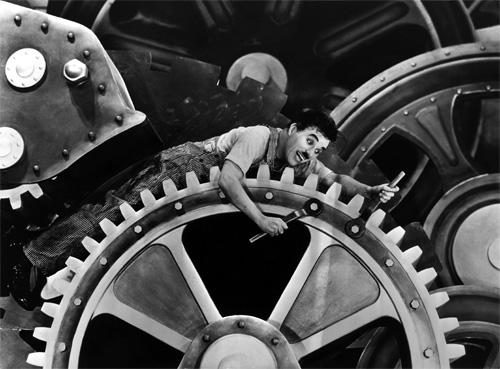
Modern Times (1936)

© Bettmann / Corbis: Modern Times.

Keaton, Buster: Raised on a tradition of vaudeville, Keaton began directing features in 1923. Unlike Sennett’s brand of comedy, Keaton’s is never ridiculous and does not undermine the dramatic logic of his narratives. His humor is based on a brainy, at times philosophical, use of irony that explores the inexorability of catastrophic actions threatening human existence. Keaton’s style is defined by his “stoneface” persona (in contrast to Chaplin’s sentimental expressiveness) and the kinesthetic energy and precise synchronization of his stunts, whose danger is part of their appeal. Keaton’s The General (1925), a box-office failure now considered a masterpiece, explores the linearity of narrative and the primacy of visual over verbal communication in silent cinema. It displays the same distrust about technology’s impact on human labor that is found in Chaplin’s Modern Times (1936).

Micheaux, Oscar: Micheaux was one of the most important American independent filmmakers of the silent era. He established the Micheaux film company and, between 1918 and 1948, wrote, directed, produced, and distributed more than 30 films. An African-American, Micheaux made films with black casts targeted at black audiences, seeking to counter the prejudiced, historically inaccurate, and disempowering representations of racial minorities in the Hollywood cinema of the period.

Dreyer, Carl Theodor: The Danish director Dreyer directed what many consider to be the greatest silent film ever made, The Passion of Joan of Arc (1928), a triumph of realism and spiritual expressiveness. Depicting the trial of Joan of Arc, the film’s courtroom scenes are shot almost exclusively in close-up, situating all the film’s meaning and drama in the slightest movements of its protagonist’s face. Dreyer continued to investigate the power of faith in a world of skepticism and hardship and the connection between the material and spiritual realms in acclaimed sound films such as Day of Wrath (1943) andOrdet (1954).
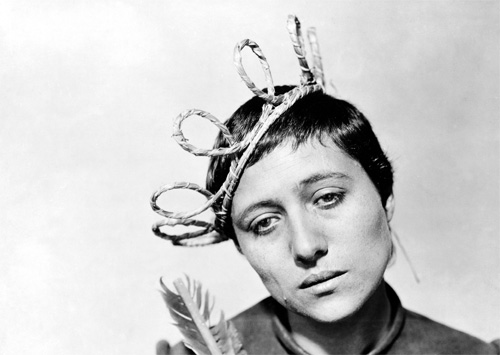
The Passion of Joan of Arc (1928)

© Corbis: The Passion of Joan of Arc.

Flaherty, Robert: Considered the founder of the documentary form, Flaherty rose to prominence with his first film, Nanook of the North(1922). It was the first feature-length documentary to become a commercial hit and inspired a generation of documentary filmmakers around the world. Flaherty’s principal innovation was to organize nonfiction events into a narrative that told a compelling story. Like many documentaries and ethnographic films, Nanook contains fictional elements, reflecting Flaherty’s admiration for Inuit culture but also his desire to cast it as a primitive society without any material relation to the modern Western world. The scrutiny overNanook’s factual accuracy has been applied to many other documentaries over the years, reflecting the increased ethical burden that documentary filmmakers bear in the presentation of their work.

Other major directors: Cecil B. DeMille, Ernst Lubitsch, King Vidor, Erich von Stroheim.
 

November 21

11/21- Check List for This Week 11/17-to-11/21

Check List for This Week 11/17-to-11/21

————————————————

1)    Project    ____    (45%)

2) Key Terms Test (Friday)  ___ (40%)

3) 11/17 Daily Assignment    ___ (15%)

4) 11/18 Daily Assignment    ___ (15%)

5) 11/20 Daily Assignment    ___  (15%)

***MAKE-UP FRIDAY****

****GET YOUR WORK DONE, AFTER TODAY YOU DROP A LETTER GRADE FOR EVERYDAY YOUR WORK IS NOT DONE********

***Wednesday 11/26- Progress Reports for 2nd qtr***

***Thanksgiving Break NO SCHOOL Thursday 11/27—Friday 11/28—-Monday 12/1****


November 20

11/20- Foley Artist & Daily Assignments

11/20- Daily Assignments

1) **Watch the three videos below***In 50-to-75 words tell me all about the Art of Foley–What is it? How does it work? How is it done? Why is it used? How often is it used? Post your essay in the comment section of this post**

Watch this video What is Foley Sound By Sound Ideas

Watch this Video on a Emmy nominated Foley Artist 

Watch this Film Riot Video on Learning to Create Your Own Sounds


2)  Project

AM CLASS– Plan and record 10 sounds using the art of Foley then put in Final Cut Pro with the sound and what effect it can be used for

PM CLASS- Take a 3 to 4 minute video, film clip, TV Show, etc and you create and dub in the sound using the art of Foley or other sound effects you can download.

3) Study With Quizlet for Key Terms Test

Click to Study with Quizlet

***Play four games and take the practice test..send the results to me in the comment section of this post****

——————————————————————————–

11/20- Today’s Lesson: What is a Foley Artist?

What IA FoleyArtist?


What It Is…


A Foley Artist ‘recreates’ sound effects for film, television and radio productions on a Foley Stage in aPost Production Studio.

Using many different kinds of shoes and lots of props – car fenders, plates, glasses, chairs, and just about anything I find at the side of the road – the Foley Artist can replace original sound completely or augment existing sounds to create a richer track.

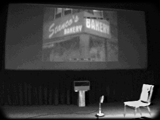
Brooklyn

The Stage Is Set

Almost every motion picture and television show you have ever seen contains a Foley track!
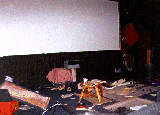
Stage

The Stage After A Fight Scene

“Don’t they record the sound when they film?”Sure, but there are many reasons why Foley is an intricate part of a soundtrack.

On a film set nothing is real – the sword is made of plastic, the marble floor is painted plywood. Foley replaces or enhances that live sound; the result is a sword that rings like metal and floors that echo like marble!

During filming, the location sound recordist tries to capture only the dialogue. Microphones are keenly positioned on set to record even an actors slightest whisper without the background noises from camera and crew. Foley helps to add back in that layer of sound to produce a rich and realistic track.
But despite the recordists best efforts, the modern world has a tendency to be loud – planes, trains and automobiles are all around us and you can’t stop the world just because you’re making a movie!Noises on location often mask the dialogue which must be replaced in a recording studio later – an actor may have to replace an entire scene or just one word!
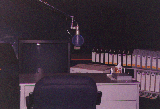
ADR Stage

An ADR Booth

This process is called Looping or Automated Dialogue Replacement (ADR.) The Dialogue Editor then conforms the ‘Production Audio’ (the live sound) and the ADR into a complete track.However, the ADR segments are clean and free of noise – it doesn’t sound natural when combined with Production. And the footsteps are missing, as well as any other action on screen. Foley fills in the gaps between the live recording and studio ADR, smoothing out the sound and creating new sounds where they are missing.


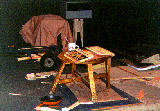
The Room

A Bar Scene Foley Style

The process of filming also creates dips in the sound since each scene is filmed from different angles over several takes for the best look and performance. Once cut together, the picture flows from shot to shot in a fluid motion but the sound can become choppy and overlapped. Once again, Foley provides a foundation that bridges these gaps.
And most productions are sold all around the world and translated in many languages. When skilled actors replace the English with another language (in ADR), a Foley track is also required to replace the footsteps and effects that are missing.


What It Isn’t…


Foley does not cover sounds like car engines, explosions or other mechanical stuff – driving a car around in the studio or blowing up a building is usually not possible although we have tried! We don’t do birds, laser blasts, dog barks or rain storms either!

These are the domain of theSound FX Editor who draws upon a sampled Sound FX library and computer technology. Everything from helicopters to thunder can be layered and mixed in to an SFX track.

FX

FX Workstation

While a Sound Editor can do very precise and repeatable effects, they have a harder time when it comes to footsteps for example, since every step is different and unique, the pace changes and the mood of the step is always different. With a good pair of shoes and years of practice, a Foley Artist can perform an actors walk perfectly on the first take while making it sound natural!In fact, one of the great ironies of Foley is that if you can tell it’s Foley, then it isn’t very good! My job is to make the sound so real that the audience would never know it wasn’t. C’est domage…


An Example…


Let’s say in a scene the actor grabs his gun, walks to his motorcycle, starts it up and drives away…

  • Foley would recreate the sound of the leather jacket and jeans as the actor walks, footsteps (heavy cowboy boots!), the gun pickup and handling, handlebar grab and bike moves – and maybe some key sounds as he puts them in the lock.
     
  • The Sound FX Editor would create the roar of the motorcycle engine starting and driving away, a tire squeal and background ambiances (birds, wind etc.)
  • In an ADR studio the actor would rerecord his line, “I’ll be back…”, which was inaudible on location with the motorcycle engine running. The Dialogue Editor would conform the production and ADR into one.

When played together, the tracks produce a seamless tapestry of sound.


How It’s Done… (click here)
November 18

11/18- Daily Assignment

11/18- Daily Assignment

1) Watch this video on Different Mics

**List the different mics in the video and what they do best**put the information in the comment section of this post

2) Watch this video on Movie Sound Effects

Make your own list of the best movie sound effects give me your top 10 list after watching the Top 50 listed in the video…send me your top 10 list in the comment section of this post

3) Watch this video on Foley Sound Effects

This is what I do! I make noise. I took footage from this public domain film and recreated the soundtrack completely. Thought you might like to see how I did it. Leave a comment down below and tell me what you think. Do you wanna see more of this stuff? There are links and info about the film in the description 

November 18

11/18- Types of Microphones

Click to Watch Video on Microphone Reviews

Click to Watch Foley Sound Effects Video

Click to Watch Video on Different Types of Microphones


Sound is an amazing thing. All of the different noises we hearare caused by minute pressure differences in the air around us. What’s amazing about it is that the air transmits those pressure changes so well — and so accurately — over relatively long distances.

If you’ve read How CDs Work, you learned about the very first microphone. It was a metal diaphragm attached to a needle, and this needle scratched a pattern onto a piece of metal foil. The pressure differences in the air that occurred when someone spoke toward the diaphragm moved the diaphragm, which moved the needle, which then recorded on the foil. When the needle was later run back over the foil, the vibrations scratched on the foil would then move the diaphragm and re-create the sound. The fact that this purely mechanical system works shows how much energy the vibrations in the air can have.

All modern microphones are trying to accomplish the same thing as the original, but do it electronically rather than mechanically. A microphone wants to take varying pressure waves in the air and convert them into varying electrical signals. There are several different technologies commonly used to accomplish this conversion. Take a look at the next page to learn more about different types of mics — including one of the first invented by Alexander Graham Bell.

Liquid microphones, invented by Alexander Graham Bell and Thomas Watson, were among the first working microphones to be developed, and they were a precursor to what would later become the condenser microphone. Early liquid microphones used a metal cup filled with water and sulfuric acid. A diaphragm was placed over the cup with a needle on the receiving side of the diaphragm. Sound waves would cause the needle to move in the water. A small electrical current ran to the needle, which was modulated by sound vibrations. The liquid microphone was never a particularly functional device, but it makes a great science experiment [source: Pemberton].

The oldest and simplest microphone uses carbon dust. This is the technology used in the first telephones and is still used in some telephones today. The carbon dust has a thin metal or plastic diaphragm on one side. As sound waves hit the diaphragm, they compress the carbon dust, which changes its resistance. By running a current through the carbon, the changing resistance changes the amount of current that flows.

the technology used in the first telephones and is still used in some telephones today. The carbon dust has a thin metal or plastic diaphragm on one side. As sound waves hit the diaphragm, they compress the carbon dust, which changes its resistance. By running a current through the carbon, the changing resistance changes the amount of current that flows.

Fiber-optic systems, which use super-thin strands of glass to transmit information instead of traditional metal wires, have been revolutionizing the field of telecommunications in recent years, including microphone technology. So what’s the big deal? Unlike conventional mics, which are often big and send an electrical signal, fiber optic microphones can be extremely small, and they can be used in electrically sensitive environments. They can also be produced with no metal, which makes them very useful in magnetic resonance imaging (MRI) applications and other situations where radio frequency interference is an issue [source: Fibersound Audio].

A dynamic microphone takes advantage of electromagneteffects. When a magnet moves past a wire (or coil of wire), the magnet induces current to flow in the wire. In a dynamic microphone, the diaphragm moves either a magnet or a coil when sound waves hit the diaphragm, and the movement creates a small current.

Electret microphones are among the most widely used microphones on Earth. Because they’re cheap and relatively simple, electret mics are used in cell phonescomputers and hands-free headsets. An electret microphone is a type of condenser microphone in which the external charge is replaced with an electret material, which by definition is in a permanent state of electric polarization [source: BeStar Acoustic Components].

n a ribbon microphone, a thin ribbon — usually aluminum, duraluminum or nanofilm — is suspended in a magnetic field. Sound waves move the ribbon, which changes the current flowing through it. Ribbon microphones are bidirectional meaning they pick up sounds from both sides of the mic.

The RCA PB-31 was one of the first ribbon microphones. It was produced in 1931, and changed the audio and broadcasting industries because it set a new standard when it came to clarity. Several other microphone makers made comparable models, including the BBC-Marconi Type A and ST&C Coles 4038.

laser microphone works by capturing vibrations off of a plane, like a windowpane, for example, and transmitting the signal back to a photo detector, which converts the reflected laser beam into an audio signal. When sound hits the windowpane, it bends and causes the laser beam to bend, which can be translated to sound using a photocell. In recent years, scientists have been developing a new type of laser microphone that works by streaming smoke across a laser beam that’s aimed at photocell, which is then converted to an audio signal [source: Van Buskirk].

A condenser microphone is essentially a capacitor, with one plate of the capacitor moving in response to sound waves. The movement changes the capacitance of the capacitor, and these changes are amplified to create a measurable signal. Condenser microphones usually need a small battery to provide a voltage across the capacitor.

capacitor moving in response to sound waves. The movement changes the capacitance of the capacitor, and these changes are amplified to create a measurable signal. Condenser microphones usually need a small battery to provide a voltage across the capacitor.

If you’re looking to record sound that’s located in front of and on the sides of the mic — but not behind it — the cardioid microphone is for you. A polar plot of the gain for cardioid is heart-shaped (hence the name), with the highest sensitivity located directly in front of the mic, and slightly less on the sides. Because of this, cardioid mics are ideal for recording live performances without capturing too much crowd noise, and many handheld microphones used to amplify vocals are cardioid mics [source: VoiceCouncil Magazine].

Certain crystals change their electrical properties as they change shape (see How Quartz Watches Work for one example of this phenomenon). By attaching a diaphragm to a crystal, the crystal will create a signal when sound waves hit the diaphragm.

As you can see, just about every technology imaginable has been harnessed to convert sound waves into electrical signals. The one thing most have in common is the diaphragm, which gathers the sound waves and creates movement in whatever technology is being used to create the signal.


November 18

Chapter 9 Audio: Sound Pickup Key Terms (Test Friday 11/21)

Click to Study With Quizlet

Key Terms Test Friday 11/21

1.audio The sound portion of television and its production. Technically, the electronic reproduction of audible sound.
2. cardioid Heart-shaped pickup pattern of a unidirectional microphone.
3. condenser microphone A mic whose diaphragm consists of a condenser plate that vibrates with sound pressure against another fixed condenser plate, called the backplate. Also called electret microphone and capacitor microphone.
4. direct insertion Recording technique wherein the sound signals of electric instruments are fed into an impedance–matching box and from there into the mixing console without the use of a speaker and a microphone. Also called direct input.
5. dynamic microphone A mic whose sound pickup device consists of a diaphragm that is attached to a movable coil. As the diaphragm vibrates with the air pressure from the sound, the coil moves within a magnetic field, generating an electric current. Also called moving-coil microphone.
6. fishpole A suspension device for a microphone; the mic is attached to a pole and held over the scene for brief periods.
7. flat response Measure of microphone’s ability to hear equally well over its entire frequency range. Is also used as a measure for devices that record and play back a specific frequency range.
8. foldback The return of the total or partial audio mix to the talent through headsets or I.F.B channels. Also called cue-send.
9. frequency response Measure of the range of frequencies a microphone can hear and reproduce.
10. headset microphone Small but good-quality omni-or unidirectional mic attached to padded earphones; similar to telephone headset but with a higher-quality mic.
11. impedance Type of resistance to electric current. The lower the impedance, the better the signal flow.
12. lavalier microphone A small mic that can be clipped onto clothing. Also called lav.
13. omnidirectional Pickup pattern in which the microphone can pick up sounds equally well from all directions.
14. phantom power The power for pre amplification in a condenser microphone, supplied by the audio console rather than a battery.
15. pickup pattern The territory around the microphone within which the mic can “hear equally well” that is, has optimal sound pickup.
16. polar pattern The two-dimensional representation of microphone pickup pattern.
17. ribbon microphone A mic whose sound pickup device consists of a ribbon that vibrates with the sound pressures within a magnetic field. Also called velocity mic.
18. shotgun microphone A highly directional mic for picking up sounds from a relatively great distance.
19. system microphone Mic consisting of a base upon which several heads can be attached that change its sound pickup characteristic.
20. unidirectional Pickup pattern in which the microphone can pick up sounds better from the front than from the sides or back.
21. wireless microphone A system that transmits audio signals over the air rather than through mic cables. The mic is attached to a transmitter, and the signals are received by a receiver connected to the audio console or recording device.
November 17

11/17- Daily Assignment/Audio: Sound Pickup

11/17- Daily Assignment


1) Read the information below and make notes on what you read. List ten things you learned after reading the information. Send that to me in the comment section of this post.

——————————–

How many times have you sat down to watch a video or budget movie, only to find that the camera work and picture editing is great, but that the sound is so bad it takes your attention away from the picture? You might even stop watching it altogether, or at least turn the sound way down. Watching a TV show, video or film should be a “complete experience,” where the picture and audio combine to produce a meaningful and well balanced whole.

However, it has often been the case that in television, cinema, and especially in amateur or semi-professional productions, that the sound has been seen as secondary to the picture. I don’t believe it should be that way. People will often put up with mediocre picture if the sound is good, but good picture with poor sound may see the ‘off switch” flicked by many viewers. So let’s set about giving a bit of an outline as to how you can go about acheiving good results with your audio.

However, it has often been the case that in television, cinema, and especially in amateur or semi-professional productions, that the sound has been seen as secondary to the picture. I don’t believe it should be that way. People will often put up with mediocre picture if the sound is good, but good picture with poor sound may see the ‘off switch” flicked by many viewers. So let’s set about giving a bit of an outline as to how you can go about acheiving good results with your audio.

Use A Separate Recording Device

‘What is wrong with recording sound using your cameras built in mics’ you ask? Well generally the quality of the built in mics and preamps in a camera is pretty average. Cameras also can have tapes or hard disks running, and other electronics that make noise which can often be picked up by the microphones. Another drawback is that to get good sound recordings, you may need to be closer to the source than the camera will allow while maintaining the right picture perspective. The best solution is to use a separate audio recording device, that is away from the camera. Many portable recording devices have built in microphones that are far superior to camera or camcorder mics. You could use the built in mics of the recording device and get better results than your camera mics, but a still better way is to use a separate microphone (or multiple mics) plugged into a portable recorder to capture sound. At a pinch you could mount a video mic to the camera, and record the audio that way. It should give you better results than the built-in camera mics, but still not really up to the standard of dedicated audio recorders and microphones. Cameras often use mini-jacks for plugging in microphones. Some smaller portable sound recorders also use this type of plug. The connections of these can be a bit unreliable, sometimes working lose, pulling out or crackling with movements. The best devices generally have XLR inputs, which lock the cable in place, and provide a much more reliable connection. Larger professional cameras normally use XLR inputs. Microphone signals are of a very low voltage, and require preamping to bring them up to a useable level. Sometimes as much as 60 or 70dB of gain is required to do this. It is important to have quality preamps in order to do this well. Poor preamps can add noise, distort signals, and generally do nasty things to the sound! Many cameras have very poor onboard preamps. A good portable recorder will have far better preamps than those found in a camera.

Another thing to consider is that audio metering in cameras is often poor, and also it’s hard to monitor these at the same time as concentrating on filming. Automatic Gain Control is also something to be avoided if at all possible, as it can introduce compression that may not be of the best quality.

A really high-end recorder like those made by Nagra or Sound Devices will have preamps that rival the best studio preamps in quality, but even quality lesser devices than these will generally better preamps than a camera. Try to use a separate recording device rather than the camera if at all possible.

If you have a couple of mics you can record them onto separate tracks in the recording device and mix these to suit later. Sometimes a field mixer (a separate device from the portable recorder) can be handy in the field where more than one source needs to be blended or mixed on the spot. However, recording everything to separate tracks if possible is going to give you maximum flexibility at mixdown later. Traditionally a field recorder and and field mixer were distinct devices,and the sound recordist carried both, but these days it is common to see devices that include both the recording and mixing functions in a single unit.

A Two Man Job

The answer to acheiving the best levels and quality of audio lies in having a second person, who is away from the camera, to be responsible for the audio recording. Their job is to monitor the sound, and not worry about having to concentrate on the filming as well. If you are really lucky you might even have a third person to man a boom pole, leaving the second person to just monitor the recording levels. The boom operator concentrates on microphone postioning. Unless it is an interview, news report, or a documentary style production, you don’t really want to see someone holding a mic or wearing a lavalier mic. To get clear speech you will want the boom operator to be able to get the microphone just out of shot above the voice. Operating a boom pole is an art in itself. The difference in level between whispering and shouting is huge, so someone needs to have eagle eyes watching the metering at all times for best results. Especially since we are not using AGC (automatic gain control). That’s the job of the person reponsible for the audio recording. Some recording devices have good limiters to catch rogue peaks before they clip, but some other devices have lousy limiters where you can hear the sound truncating abruptly. Manual gain control and/or light compression usually gives more natural results. However, compression is best left to someone who is experienced and knows what they are doing. Novices should probably not try to use compressors while recording, as the results of poor compression can’t be undone. Set levels manually, and if you have a limiter of a known high quality, you could use that to catch any extreme transients. If a limiter is being triggered constantly the results will not be pleasant. Backing off the gain will produce more natural and pleasing audio than sound that has been heavily limited or compressed.

What Type of Microphone should I Use?

In most cases for use in location recording a directional shotgun mic mounted to a pole is the best option. There are a number of models of shotgun microphones available, ranging from relatively cheap, to very expensive at the high end. The Sennheiser MKH416 is the traditional standard mic here. Rode Australia makes some good model shotgun mics for those with a lower budget. The mic can be plugged directly into your portable sound recorder if it has in-built mic preamps. Shotgun mics are very directional and have good rejection of sound to the sides. You will need some kind of shockmounting to prevent handling noise, and if outdoors some sort of wind protection as well. Low rumbles and wind noise can really marr a recording. A blimp or zeppelin style shockmounted microphone enclosure, covered with a fluffy fur type windjammer is ideal for outdoor shoots. A foam windsock alone over a microphone capsule is not sufficient to block out wind noise and rumble. For recording general of atmos and ambience, as well as shotgun mics, fixed polar pattern (such as cardiod) condensor mics can be useful. If you want a stereo atmos sound there are various ways to position mics for this, but I won’t go into those here. An example would be an X-Y pattern. I find small diaphram condensor mics handy for this. Special stereo mics are also an option. If your recorder has onboard stereo mics of sufficient quality you may even want to use those.

Sync’ing Video and Audio

Recording of picture and video separately requires some way of sync’ing otherwise it will result in a shambles. If you have multiple cameras and an audio recorder, you will need to be able to keep these perfectly sync’ed so that you can align them during editing. The simplest way to do this is to use a clapper board, or someone using a single handclap in view of all the cameras, and with the audio rolling in record. It is important that everyone can see the clapperboard or hand clap, and that there is only a single clap at the start of each recorded clip, to minimize the risk of confusion as to the start of the cut. It will then be easy to align all the audio tracks and film in the edit suite. A clear procedure of ‘calls’ that everyone on the shoot is familiar with is essential to maintining an orderly shoot. Traditionally in film an asistant would call “turnover,” at which point the sound recordist would call back “speed” once he had hit the record button. The camera operator starts his camera rolling and calls “turnover,” and the sound recordist replies back “speed,” before the cameraman calls “mark” for the clapperboard to be clapped. Then the dirctor calls “action”. In our case, so that everyone knows all devices are in record, we should follow a similar procedure. I prefer to use terms words like “roll sound” or “roll film”, and having worked in television, I am much more used to the term “cue” rather than “action”. Whatever words you use, make sure that everyone involved is clear as to their meaning. It’s also a good idea to take notes on each scene that could make things easier later when editing. This is Known as “slating.”

Timecode

The recording of picture and sound and their syncing on a location shoot using type above method should work well in most situations, though it is possible for small drifts in timing that may require correction due to the different internal time clocks of all the devices. If you are using analog tape or film it is most likely to be noticeable. Our clapperboard only gives us the beginning point of our film, and so that is our main reference, but nothing solid as timing reference from there on in. In television or larger film productions, a method of time aligning using time code is the norm, where everything is sync’ed to one clock, keeping things tightly aligned frame to frame, throughout the record process. SMPTE/EBU timecode uses a string of eight numbers that make everything easily identifiable on a timeline. The numbers are hours, minutes, seconds and frames. For example 03:24:37:16 read on a timecode would mean three hours, twenty-four minutes, thirty-seven seconds and sixteen frames. The hours are in 24 hour format, the minutes and seconds as normal from 00 to 59, and the frames from 00 to 29. It is not within the scope of this article to go into depth on understanding timecode, as it can be quite complex to understand and deserves it’s own separate explanation.

In the Editing Suite

Once we have our video and audio recorded and we get them back to our editing software, we need to align the “clap” from each camera and audio track to give the start point of the clip. Cut all tracks at the point of the initial transient of the handclap and work from there. Go to the end of the take and check to make sure everything is still aligned there too. Hopefully it will be. If a single timecode clock has been used it almost certainly will be. However, if we have not used timecode, and just the “clap” method, if it has been a long scene, it is possible that timing errors may have crept in. If you find further along that sync has slipped, try to find a clearly identified event further into the scene, and cut and re-align here. Plosives sounds such as “B’s” and “P’s” can be good because they are clearly visible in the audio, so you could use them as your reference, so long as the person speaking is also clearly visible in your picture. Sounds such as “p” and “b” should occupy only one frame, which should make re-alignment relatively easy. Otherwise you will need to find another clearly evident transient in the sound that is also clearly visible in the picture, and use that for aligning.

Summing Up

As you can see here I am passionate about sound and I get irritated by poor sound in video, film or television. Sound quality in youtube is often even worse. Let’s all do our part to improve things. I hope in this article that I have given you a few basic ideas to get you thinking about improving the sound of your next production. Your aim should be to give the viewer a good listening and viewing experience, or one that doesn’t distract them from the topic if it’s a documentary or similar. So don’t cut corners and take short cuts with your audio if at all possible.

2)  Watch this video Filmmaking 101- How to Record Good Audio

Learn the equipment and skills you need to be a great sound technician/boom operator on your film set!
This is a perfect sound recording tutorial for an HDDSLR Filmmaker, who’s just starting out. You’ve got your great HDDSLR camera and a nice lens, but you need audio to match! LIST THE TEN THINGS YOUR LEARNED FROM THE VIDEO…Send the info in comment section of this post.


November 17

11/17- Audio: Sound Pickup

Watch this Sound Design Tutorial For Film: Audio and Pre-Production

Watch this Film Riot Video on Production Audio

Watch this Video Sound Design- Star Wars Episode II

Audio is the bane of every low-budget and independent filmmaker’s existence. It’s the one thing most filmmakers have the least amount of experience with, but also the least of amount of time to deal with properly. If you want the best possible audio on set, it takes just as much work as getting a good image. Since this is a visual medium, there’s no question the moving images should be the best they can be, but often the quality of the audio matters more than the quality of the video. For anyone starting out, here’s a quick video and then some simple tips about getting better production audio.

Production Dialogue – Microphone Placement

Click to Watch Production Dialogue- Microphone Placement

It’s always a good idea to get the microphone as close as humanly possible to the mouth of speaker. This may seem like common sense, but all too often the boom operator and the camera operator are not in communication and you end up with a microphone that could be much, much closer to the actors and still out of frame (this is what boom operators mean when they are asking for a frame line). Here are some tips for getting the best production audio possible:


  1. Work on the problem areas for the space you’re in. Use sound blankets (or any type of heavy cloth material) in front of surfaces that tend to reflect a lot of sound. For example, windows are usually the worst offender in terms of sound pollution, so covering them will help tremendously.
  2. Always boom away from windows and other noise pollution when you can.
  3. Unplug any unnecessary devices that could cause issues, for example, refrigerators.
  4. Develop a strategy for where you’ll stand if you’re operating the boom. Find the closest position possible to the actors, and it will limit your strain and help keep the boom steady, not to mention help get the microphone closer to the actors.
  5. Going from above is usually preferable, but if you don’t have a choice, booming from underneath the actors might help you get closer.
  6. Whenever you’re recording anything without a mixer, record the levels as high as possible before clipping. This ensures that your levels will not have to be brought up in post, which tends to increase noise greatly.

Audio is one of the few places where corners can’t be cut. Bad sound can ruin an otherwise brilliant film, so if you don’t have the experience already or the time to learn the skill properly, try to find or hire someone who does. The audience may not notice, but that’s really the goal in the end, to keep them focused on the story and not the production values.

For some other audio tips, check out the audio chapter in the DSLR Cinematography Guide, and this guide to audio post-production using Premiere.


November 14

11/14- Daily Assignment CNN Student News Quiz

11/14- Daily Assignment

CNN STUDENT NEWS QUIZ

***Answers the questions below and send them in the comment section of this post***

1. The U.S. is planning to double the number of its troops, bringing the total to about 3,000, in what Middle Eastern nation?

2. For Cabinet nominations, the U.S. Constitution requires the president to seek the advice and consent from what part of the government?

3. In what year did the Berlin Wall “fall,” allowing people to travel freely between East and West Berlin?

4. What agency of the U.S. federal government was recently hacked, potentially exposing the information of 750,000 employees and 3 million customers?

5. Armistice Day was named for an event that took place on November 11th of what year?

6. What country hosted the APEC summit, where President Obama met with other world leaders this week?

7. What is the name of the European Space Agency mission to Comet 67P?

8. What two-word term describes a political session between an election and the time when the newly elected leaders take office?

9. After Mexico, name one of the two leading countries of birth for new U.S. residents.

10. What is the smallest U.S. state, measuring 48 miles long and 37 miles wide?