1/6- Daily Assignment
1/6 Daily Assignment
Click to Watch Video on Three Point Lighting
Click to Watch this Video on Three Point Lighting
1) Watch the 2 Video’s above and in your own 50-to-75 words explain three point lighting. What it is? Why you use it? How do you use it? When do you use it?
2) Define the words below:
1) Fill Light-
2) Back Light-
3) Key Light-
4) falloff-
5) high-key-
6) kicker light-
7) low-key-
8) side light-
9) diffused light-
10) silhouette lighting-
The Standard 3-Point Lighting Technique
The Three Point Lighting Technique is a standard method used in visual media such as video, film, still photography and computer-generated imagery. It is a simple but versatile system which forms the basis of most lighting. Once you understand three point lighting you are well on the way to understanding all lighting.
The technique uses three lights called the key light, fill light and back light. Naturally you will need three lights to utilise the technique fully, but the principles are still important even if you only use one or two lights. As a rule:
- If you only have one light, it becomes the key.
- If you have 2 lights, one is the key and the other is either the fill or the backlight.
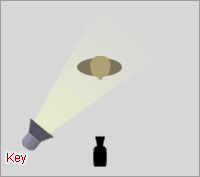
Key Light
This is the main light. It is usually the strongest and has the most influence on the look of the scene. It is placed to one side of the camera/subject so that this side is well lit and the other side has some shadow.
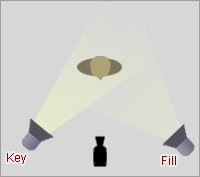
Fill Light
This is the secondary light and is placed on the opposite side of the key light. It is used to fill the shadows created by the key. The fill will usually be softer and less bright than the key. To acheive this, you could move the light further away or use some spun. You might also want to set the fill light to more of a flood than the key.
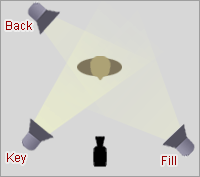
Back Light
The back light is placed behind the subject and lights it from the rear. Rather than providing direct lighting (like the key and fill), its purpose is to provide definition and subtle highlights around the subject’s outlines. This helps separate the subject from the background and provide a three-dimensional look.
If you have a fourth light, you could use it to light the background of the entire scene.
****Send the Daily Assignment in the Comment section of this post, or you can write or type and hand into Mr. Schoener by the end of class*****